The Hormuz Disruption Reaches Central Asia Through Chinese Demand
By: Sobir Kurbanov and Eldaniz Gusseinov
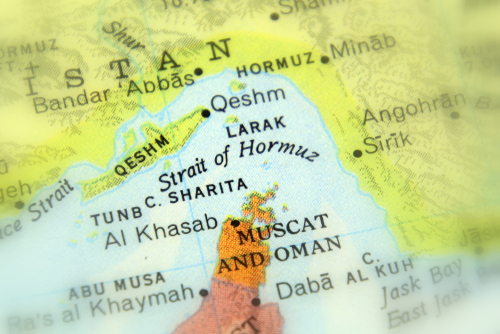
The renewed closure of the Strait of Hormuz, which followed the strikes on Iran of 28 February 2026, has tested world energy markets without producing the price spike that most forecasters expected, and the main reason lies in China. Chinese crude imports fell to 7.1 million barrels per day in June against a 2025 average of 11.6 million, while refinery utilisation dropped to 57.7 percent. For Central Asia the consequence arrives indirectly, because the same weak Chinese demand that has capped crude prices is also depressing the steel, iron ore and ferroalloy prices on which Kazakhstan’s metallurgical sector depends. The chokepoint that Beijing is building Central Asian corridors to bypass is now transmitting its own shock into the region through the very relationship those corridors are meant to deepen.
BACKGROUND:
The Strait of Hormuz carries roughly 20 percent of global oil consumption and a comparable share of liquefied natural gas, with no overland substitute at scale for most Gulf producers. The International Energy Agency warned on 12 August 2026 that Hormuz-related losses would cut global oil supply by 4.3 million barrels per day across the year, and that a projected demand increase of 850,000 barrels per day had reversed into a decline of 1.6 million. Prices rose sharply, yet the escalation that many analysts anticipated did not materialise, because the largest buyer withdrew from the market at the same moment.
On 5 March 2026 China ordered its largest refiners to suspend diesel and gasoline exports, and refiners began cutting throughput and bringing scheduled maintenance forward within days. A structural change compounded the cyclical one. GL Consulting estimates that Chinese gasoline consumption will fall 5.5 percent in 2026, the second steepest decline after the lockdown year of 2022, with retail prices up roughly 30 percent since late February and electric vehicles absorbing a growing share of the fleet. China entered the disruption holding approximately 300 million barrels of cheap crude accumulated over the 14 months before the war, a buffer that is substantial and finite.
Central Asia is too integrated into external markets to insulate itself from a shock of this size, and yet the shock does not arrive directly. Kazakhstan ships most of its crude westward through the Caspian Pipeline Consortium rather than through the Gulf, and the region’s hydrocarbon trade with China moves by pipeline, which protects volumes while leaving prices exposed. External disturbances therefore reach Central Asian economies through three intermediaries, Russia, China and the European Union. Residents of the region learned the shape of that transmission in 2022, when the war in Ukraine reached household budgets through remittances, Russian banking channels and rerouted transit rather than through any direct commercial link. The present episode follows a different path. In Temirtau and Aktobe, where employment is concentrated in steel and ferroalloy plants, and in Karaganda region, the connection between a maritime chokepoint 3,000 kilometres away and local order books is neither obvious nor remote.
IMPLICATIONS:
The transmission runs through Chinese construction. China accounts for roughly half of world steel output, and construction absorbs about 49 percent of that steel, down from 58 percent in 2020. The property downturn has deepened rather than stabilised. Between January and May 2026, housing sales declined 10.8 percent by floor area and 13.5 percent by value, new construction starts fell 22.6 percent and property investment fell 16.2 percent. Weak demand for steel pulls down the inputs that Kazakhstan sells into it.
According to analysis published by the Kazakh sector channel Metals and ESG Trends.KZ, falling steel demand has depressed prices for iron ore, ferrochrome, silicomanganese and ferrosilicon, with ferrosilicon down by approximately 30 to 35 percent and pressure building on Qarmet, ERG and the country’s independent ferroalloy producers. These figures come from a sector channel rather than from exchange data and should be treated as indicative, though they are consistent with the direction of Chinese construction indicators.
The oil shock is mainly a reversible supply-and-refinery disruption, although China’s underlying oil-demand trend is weakening. The ferrous challenge is more structural: China’s property sector is unlikely to restore the previous steel-demand regime, while Chinese overcapacity may intensify competition in Kazakhstan’s surrounding markets. Kazakhstan therefore needs not only short-term support, but a multi-year strategy of market diversification, productivity improvement and product upgrading.
The more consequential implication concerns the logic of integration itself. Chinese investment in processing industries across Central Asia has reached an estimated US$ 11.8 billion against US$ 4.1 billion in energy, reversing the historically extractive pattern, and the China-Kyrgyzstan-Uzbekistan railway began construction in 2025. Nightingale Int. argued in October 2024 that Beijing would move from buying commodities in the region to embedding it in Chinese industrial chains, a forecast that BYD’s full localisation of electric vehicle production in Uzbekistan has since borne out. That investment is driven substantially by the same chokepoint exposure now visible at Hormuz. Central Asia is therefore receiving Chinese capital because China needs a continental rear, and absorbing Chinese demand shocks because it is becoming one. Deeper integration raises both the opportunity and the correlation.
Transit revenue moves with the same cycle, since corridor volumes through Central Asia are weighted toward Chinese cargo, and traffic on the Trans-Caspian Transport Corridor reached 4.5 million tonnes in 2024 before easing in 2025. Kyrgyzstan and Tajikistan face a different version of the problem. Neither exports ferroalloys at scale, and both carry sovereign debt to China equivalent to roughly 9.5 percent and 6 percent of GDP respectively, servicing obligations denominated against a creditor whose own fiscal position is tightening. A prolonged Chinese slowdown compresses their repayment capacity and their construction pipelines at once.
Kazakhstan’s emerging answer is visible in Karaganda region, where new copper extraction and processing projects are advancing and diversification into non-ferrous metals has become a working scenario for the sector. The direction is sound, and the caveat is familiar. Announced projects are not deployed capacity, and copper demand is itself concentrated in Chinese buyers. Diversification that changes the commodity while leaving the customer unchanged reduces exposure to one construction cycle and not to one counterparty.
CONCLUSIONS:
The Hormuz disruption has demonstrated that Central Asia’s exposure to global shocks is now mediated primarily through China, and that this channel operates in both directions. Beijing’s search for continental redundancy is drawing capital, factories and corridors into the region, while the maritime vulnerability that motivates that search transmits demand shocks back along the same route. If flows through the strait normalise within 2026, the oil-linked component will unwind. The ferrous component will not, because it rests on a Chinese property contraction that predates the conflict and is expected to persist. For Central Asian governments the practical lesson concerns buyers rather than corridors. Multi-vector policy has been articulated mostly in terms of routes and creditors, and the present episode indicates that the diversification that matters most is the diversification of demand.
AUTHOR’S BIOS:
Sobir Kurbanov is an international development expert and fellow at Nightingale Int. with over 20 years of experience in partnership-building, complex market reforms, program management, and teaching policy reform, public sector economics, and industrial policy across Eurasia. His expertise spans macroeconomic management, public sector governance, private sector development, trade, investment climate, infrastructure, and IF4D portfolio management, with a strong track record of working with bilateral and multilateral donors (SECO, DFID, USAID, IMF, WB, EU, UN), governments, CSOs, and think tanks, and leading cross-functional teams to advance evidence-based policy solutions.
Eldaniz Gusseinov is co-founder and Head of Research at Nightingale Int. and a non-resident fellow at Ibn Haldun University’s Haydar Aliyev Center for Eurasian Studies.
How Pakistan Is Reshaping Eurasian Trade Corridors
By Umair Jamal
Pakistan has approved and operationalized new land routes to connect Central Asian markets to Pakistani ports and beyond, utilizing strategic corridors through Iran and China to bypass Afghanistan entirely. This shift was solidified in April 2026 when Pakistan Customs launched the first export consignment from the Karachi Export Processing Zone to Kyrgyzstan via the Sost Dry Port in China under the TIR (Transports Internationaux Routiers) regime. Pakistan’s decision to diversify transit away from Afghanistan follows the indefinite closure of the Torkham and Chaman border crossings in October 2025 due to unmanageable security risks and cross-border militancy. By activating the Pakistan-Iran Transit Corridor and the Sost-Kyrgyzstan-China Corridor, Islamabad is dismantling Afghanistan’s traditional transit monopoly. Amidst the ongoing Strait of Hormuz crisis, these land routes, coupled with the rising prominence of Gwadar Port, position Pakistan as a critical, multi-modal bridge between the landlocked Eurasian heartland and global warm-water ports. These new land routes circumvent both maritime chokepoints and regional instability and provide Central Asian nations with secure and diversified avenues for trade and logistics.

BACKGROUND:
For decades, Pakistan’s overland access to the Central Asian countries was almost exclusively dependent on the Chaman and Torkham gateways through Afghanistan. From Pakistan’s perspective, this geographical bottleneck granted Kabul significant leverage, which was frequently used as a political tool during bilateral friction. However, since the Taliban’s return to power in 2021, this lifeline for both Central Asian states and Pakistan has transformed into a strategic liability.
Central Asian leadership has grown increasingly frustrated with the instability of the Afghan route. For instance, recurrent border closures, unpredictable transit fees, and the persistent threat posed by militant groups have undermined the region’s trade ambitions. This collective annoyance reached a decisive moment in October 2025, when in response to persistent cross-border militant attacks from Afghanistan, Pakistan decided to completely shut down the Afghan-Pakistani trade routes connecting Central Asia.
Seeking to bypass traditional transit hurdles, Pakistan recently proposed new trade corridors for Central Asian countries. In April 2026, senior representatives from Uzbekistan, Kyrgyzstan, and Tajikistan gathered in Karachi for a coordination ceremony, where Pakistan offered a permanent alternative to the Afghan route for global connectivity.
The ceremony marked the official activation of the Iran-based land route, with the first convoy of refrigerated trucks carrying frozen meat and assorted exports destined for Tashkent and Bishkek. The development signaled a regional consensus whereby Central Asia is no longer willing to wait for Afghan stability and seem poised to work with Pakistan to operate these new routes. Early data reflects this momentum, with over 14,000 metric tons of cargo successfully processed across both corridors.
Simultaneously, Pakistan’s private sector has already demonstrated that it can work via the northern bypass that sits on China’s Sost border, with the Hemani Group successfully delivering a 23.9-tonne consignment to Kyrgyzstan, cleared electronically via the Pakistan Single Window (PSW) system. This 3,300-kilometer Bishkek-Karachi route under the Quadrilateral Traffic in Transit Agreement (QTTA) has now seen its first reciprocal commercial runs, with Kyrgyz transport fleets bringing minerals and textiles south. Crucially, the cargo proved the viability of two-way transit over high-altitude passes, shifting the framework from a unilateral export pipeline into a functional bilateral trade loop.
These strategic developments are taking place at a crucial time in the region’s geopolitics and are set to have far reaching implications.
IMPLICATIONS:
These new corridors have immense strategic significance for Central Asia, as they offer a permanent exit from the long-standing Afghan dilemma. For instance, by utilizing the Gabd-Rimdan from Iran and Sost that relies on China, landlocked nations such as Uzbekistan and Kyrgyzstan have secured a reliable Southern route to the Arabian Sea. Uzbekistan has been particularly active along the western axis, using the Gabd-Rimdan border terminal, which was recently upgraded by the National Logistics Corporation (NLC) with modern scanning facilities, to consistently move agricultural equipment and industrial raw materials.
The diversification provides these countries with a professionalized trade environment characterized by reduced transit costs, effectively bypassing the unpredictable informal taxes and security delays inherent in the Afghan route.
Furthermore, the distance from the Iranian border to Gwadar port offers a significantly shorter alternative to the traditional northern routes through Russia or the volatile western corridors, while maintaining stability through direct institutional oversight via the TIR regime and electronic tracking under the Pakistan Single Window (PSW) system. This structural predictability has provided Central Asian exporters with a reliable maritime gateway that avoids the costly and multi-border transit loops through eastern Europe.
In the wake of these developments, Pakistan’s Gwadar Port is set to transition from a conceptual hub into the functional heart of Central Asian trade. Within the framework of the China Pakistan Economic Corridor’s Phase 2, the integration of trade from Central Asian countries via Iran and China validates the massive infrastructure investments previously made in Baluchistan.
This development is particularly critical given the ongoing Strait of Hormuz crisis. Gwadar is situated 400 km east of the strait and serves as a virtual bypass of the conflict zone, allowing Central Asian exports to reach international waters without entering the high-risk zones of the Persian Gulf.
For Pakistan, this creates a substantial economic windfall as well. By positioning itself as the primary transit state for a massive market, the country is positioning itself to secure consistent revenue through port handling, logistics, and transit fees. In the wake of the Strait of Hormuz crisis, tariff at the Gwadar port has multiplied.
Ultimately, these shifts represent a permanent structural setback and the long-term erosion of Afghan leverage. For decades, Kabul relied on its geographic status as a bridge between South and Central Asia to extract economic concessions and maintain political relevance. However, by demonstrating that trade can flow efficiently through Iran and China, Pakistan and the Central Asian countries have rendered the Afghan routes entirely optional.
If the Taliban regime remains unable or unwilling to secure its borders and dismantle militant sanctuaries, it faces the grim prospect of total economic isolation as regional trade patterns permanently realign around a more stable and predictable maritime-linked architecture.
Moreover, the strategic expansion of these corridors comes at a pivotal moment in the shifting Eurasian geopolitical landscape.
As the Iran-U.S. war reshapes regional alignments and trade security, these new routes grant Pakistan and Central Asia much-needed strategic maneuverability. They serve as a vital hedge, insulating regional economies from the instability of maritime corridors and the growing risk of chokepoint weaponization.
Furthermore, this realignment signals the emergence of a Middle-Power bloc where regional players like Pakistan, Iran, and the Central Asian Republics are prioritizing economic connectivity over historical ideological or security frictions.
For Pakistan, this transition from a security state to a geo-economic hub is not just about transit fees; it also constitutes an attempt to embed its stability with the economic wellbeing of its neighbors.
By providing a new route for Eurasian goods, Pakistan is trying to ensure that regional powers now have a vested interest in the security of Pakistan and the success of Gwadar port where Central Asian states will now have significant stakes.
CONCLUSIONS:
The approval of these alternative corridors demonstrates an important elevation of Islamabad’s regional standing. By linking Gwadar to Iranian and Chinese land routes to better serve Central Asia, Pakistan is effectively seeking to decouple its economic future from the instability of traditional Afghan transit. This development offers a stable gateway for regional states and signals a shift away from reliance on uncooperative neighbors. As the idea of Eurasian trade flowing through this multi-dimensional network gains relevance, Pakistan is going to position its southern coast as the indispensable hub of a new and more resilient economic order.
AUTHOR’S BIO:
Umair Jamal is a Ph.D. candidate at the University of Otago, New Zealand, and an analyst at Diplomat Risk Intelligence (DRI). His research focuses on counterterrorism and security issues in Pakistan, Afghanistan, and the broader Asia region. He offers analytical consulting to various think tanks and institutional clients in Pakistan and around the world. He has published for several media outlets, including Al-Jazeera, Foreign Policy, SCMP, The Diplomat, and the Huffington Post.
Central Asia's Educational Mobility Is Moving Beyond Its Old Default
By Jordan N. Troisi
Russia’s recent school enrollment restrictions and rigorous language testing for Central Asian migrant children underscore a fraying post-Soviet educational default. While Russia remains an inherited educational pathway, its relative dominance is being eroded by its own restrictive policies, new external destinations, and Central Asian states becoming destinations in their own right. Consequently, states and institutions seeking a role in the region’s education landscape can no longer rely on old geopolitical defaults or view Central Asia simply as an outbound market. To remain credible, they must build tangible, long-term pathways tailored to the practical push and pull factors shaping student mobility.

BACKGROUND:
As a legacy of its imperial and Soviet past, Russia has remained the default international education pathway for many Central Asian students since the dissolution of the Soviet Union, with language, credentials, professional networks, labor migration, and family mobility reinforcing one another. This is partly why Russian influence has endured; education sits inside a broader inherited system rather than apart from it. However, Russia itself is complicating its position as a welcoming destination. Its crackdown on Central Asian migrants, expanding since 2024, now bars children of immigrants from attending Russian schools unless they pass a difficult Russian-language exam and their parents prove legal registration. Early implementation results showed that only about 19 percent of migrant children applicants were even allowed to take the proficiency exam. Many families, reading the writing on the wall, are considering returning home. These pressures matter because educational mobility, particularly toward former colonial powers, often begins before university through questions of language, schooling, legal status, and future work opportunities.
At the same time, a recent New Lines Institute article argues that the U.S. has an opportunity to expand influence in Central Asia through higher education, framing international education in the region primarily as a contest between Washington and Beijing. This correctly identifies the strategic importance of educational diplomacy but misses the wider regional picture. Flattening Central Asia’s educational mobility into great power competition risks overlooking the perspectives of those making mobility decisions. Central Asian students are part of a global movement of nearly 7.3 million students studying abroad, and while geopolitics shape their available options, the push and pull factors influencing their decisions are inherently practical.
In short, educational mobility in Central Asia is becoming increasingly complex, not because one actor is being displaced by others, but because the old default is eroding under the pressure of overlapping factors and the availability of new options. Those who continue to read the region simply as an outbound market or primarily as an arena of great power competition risk misunderstanding this shift and missing opportunities for deeper ties with an increasingly consequential region.
IMPLICATIONS:
This shift has three major implications. First, recruitment alone is no longer enough. Central Asian students continue to seek educational opportunities abroad, but in an increasingly crowded market, access alone is a thinner basis for engagement. As students gain more options, destinations and programs that offer little beyond admission will be less compelling than those that connect education to recognized credentials, professional mobility, and credible post-graduation opportunities. The countries and institutions that understand this will be better positioned than those that treat student mobility as a matter of simply attracting students outward.
Second, states and institutions are increasingly building within the region, not only recruiting from it. This includes newer entrants, like the EU, which held the first Central Asia–European Union University Congress, in Samarkand in April 2026. The congress framed engagement not only around student exchange to Europe, but as an “important platform to advance academic cooperation,” with Uzbekistan touting more than 50 signed agreements and stronger partnerships with European universities.
It also includes China, which has moved furthest in this direction. Rather than simply trying to displace Russia by student volume, it is folding education into a larger regional presence and longer-term strategy. Education is being linked to technology, infrastructure, language, and vocational capacity, making China one of the most active emerging education actors in the region. Indicative of this shift, in April it opened additional Luban Workshops in Turkmenistan, including at the International University of Oil and Gas during a high-level visit by First Vice Premier Ding Xuexiang. This fits into a broader Chinese regional strategy that is picking up pace. At the June 2025 China-Central Asia Summit in Astana, President Xi said China was ready to expand cultural centers, university branches, and Luban Workshops across the region, while launching new Central Asian language programs in Chinese universities and continuing the China-Central Asia technology and skills improvement scheme. Under this model, education is more than soft power; it supports the development of infrastructure for long-term regional cooperation.
Third, Central Asia itself is becoming a destination, further complicating the old outbound model. Kazakhstan is leading the way, with the government seeking to host 150,000 international students by 2029. Recent news from Uzbekistan illustrates a shift in both directions. In 2025, Uzbekistan’s outbound education travel fell to 28,954 students amid rapid domestic educational growth. Russia, narrowly ahead of Tajikistan, remaining the top international destination. At the same time, the growing presence of Uzbek students in South Korea shows that mobility is spreading across a wider map. Meanwhile, Uzbekistan reported that incoming international students rose over 54 percent, mainly from India, Turkmenistan, and Tajikistan, with smaller increases from Pakistan and China. This expansion occurs alongside deeper institutional engagement, with the number of foreign universities in Uzbekistan increasing to 30 in late 2025. Kyrgyzstan has seen similar results. Among its 49,553 international students by the start of the 2024 academic year, Uzbekistan was the largest sender, followed by India and Pakistan, reported IOM.
Together, these cases trace a shift away from treating Central Asia primarily as a recruitment market, toward a more complicated mobility landscape. Today’s education pathways shape tomorrow’s economic opportunities, which is why the stakes extend beyond student numbers. International educational engagement increasingly depends less on abstract soft-power appeals than on the ability to build credible, usable, and durable pathways. As Central Asian students and families gain more options, they are becoming more discerning decision-makers. Institutions and countries interested in engaging with the region should take note.
CONCLUSIONS:
Russia’s restrictions on Central Asian migrant children are not just a matter of domestic education policy. They are a signal that the old post-Soviet educational default is fraying. Central Asia’s student mobility is not shifting from Russia to another concentrated center, but becoming increasingly pluralistic, shaped by new destinations, regional alternatives, and family calculations about long-term opportunities. The strategic significance is not that students are choosing geopolitical sides; it is that educational engagement now depends less on recruitment alone and more on whether states and institutions can build credible pathways in an increasingly pluralistic landscape.
States and institutions that recognize this shift early will be better positioned to build durable educational ties, while those still relying on dated frames of Central Asia as a recruitment market or secondary arena of great power competition risk falling behind in a region already on the move.
AUTHOR’S BIO:
Jordan N. Troisi is a doctoral researcher in Global Studies in Education at the University of Illinois Urbana-Champaign and former Country Director for American Councils for International Education in Azerbaijan. Based in Tashkent, his research examines how geopolitics shapes student mobility and transnational education. The views expressed in this article are the author’s own and do not represent any institution or organization.
China Tests its Global Stabilizer Role in the Afghan-Pakistan Conflict
By Masom Jan Masomy and Eldaniz Gusseinov
Among external stakeholders, China bears the heaviest cost from the ongoing Afghanistan-Pakistan tensions along the Durand Line. The conflict erodes Beijing’s credibility as a regional mediator on the dispute-resolution front, even as its short-term containment record remains defensible. Both Afghanistan and Pakistan continue to depend on Chinese economic engagement, and both are seeking to expand investment flows from Beijing. China has hosted at least seven formal rounds of the China-Afghanistan-Pakistan Foreign Ministers’ Dialogue, its primary platform for structured mediation between the two countries and has intervened repeatedly with emergency shuttle diplomacy during acute crises, most recently during the open military confrontation.
Photo by Crystal51, 2015
BACKGROUND:
For a state positioning itself for a more influential role in the emerging global order, mediation has become a core instrument of strategic projection. This ambition found formal expression in Beijing’s May 2025 white paper, “China's National Security in the New Era.” Released by the State Council Information Office on May 12, the document represents the first dedicated national security policy statement since the founding of the People’s Republic. Its opening chapter frames China as a source of certainty and stability in a turbulent world, and the same self-positioning runs throughout the text. By tying political security to international order within a single "holistic" framework, with economic development as the connecting axis, Beijing presents its own internal stability and modernization as stabilizing forces for the broader international system. The Afghan-Pakistan file is currently the closest test of that framing on China’s periphery.
The results have been limited. China has not resolved the underlying disputes between Afghanistan and Pakistan, and each failed mediation round makes the next one harder to frame as credible. Experts generally agree that Chinese mediation acts as a “band-aid” over structural wounds. The long-term drivers of hostility remain untouched: Islamabad’s demand that the Taliban crack down on TTP safe havens, and the historically unrecognized Durand Line that sits beneath nearly every bilateral grievance. Strategic distrust between Kabul and Islamabad has only hardened since 2021. On short-term crisis containment, however, Beijing’s record is defensible. It pulls both sides back from open war and keeps communication lines open, with the promise of the Belt and Road Initiative (BRI) used as an economic incentive to buy time, even when this does not produce durable agreements. For Beijing, short-term containment is “good enough” provided it prevents a regional collapse that threatens Chinese investments.
Pakistan’s declaration of “open war” on Afghanistan in late February 2026 produced significant civilian casualties across the country. On March 16, Pakistani airstrikes hit the Omid Addiction Treatment Hospital in Kabul. Afghan officials placed the death toll at approximately 400 patients, a figure that has not been independently corroborated. Human Rights Watch verified at least 143 killed and over 250 injured. Islamabad denied intentionally targeting the facility. By April 5, Taliban officials reported cumulative civilian casualties of 761 killed and 626 injured since late February, figures the United Nations has not fully verified. Prior to the hospital strike, UNAMA had documented 76 civilian deaths and 213 injuries from clashes beginning on February 26 and called for compliance with international humanitarian law.
The most recent mediation round, hosted by China in Urumqi, did not yield a permanent ceasefire between Kabul and Islamabad. It did, however, halt active kinetic conflict and keep further negotiation tracks open. Earlier mediation attempts by Qatar and Turkey, with parallel engagement from Saudi Arabia, sought to reduce escalation. Afghanistan and Pakistan have nonetheless experienced their most serious deterioration in relations since the Taliban seized power in 2021. Major trade routes at Torkham and Spin Boldak have remained closed since the October 2025 clashes, disrupting bilateral trade flows.
IMPLICATIONS:
Tensions between Afghanistan and Pakistan stem largely from Islamabad’s claim that the TTP operates from Afghan territory and conducts attacks inside Pakistan. Kabul’s immediate rejection of this claim has strained the bilateral relationship since August 2021. The unresolved dispute undermines Pakistan’s capacity to control its borderlands and opens space for non-state armed groups to regroup in remote border regions, a development that also concerns regional neighbors.
In this context, China’s mediation efforts stem from deeper structural stakes, linking border security and regional connectivity. For China, any instability or rise in militant mobility across the narrow Wakhan corridor or in the Pak-Afghan region raises long-term security questions. This issue is critical to China’s implementation of transportation projects across Eurasia. Discussions between China and Central Asian states also covered the potential integration of transport projects, including proposals to connect the China-Kyrgyzstan-Uzbekistan railway, currently under construction, with Uzbekistan’s proposed Trans-Afghan railway. Under this configuration, the combined route would originate in Kashgar and, via Afghanistan and the CPEC, terminate in Gwadar. The result is a ring of Chinese influence spanning Central and South Asia. China would be positioned to integrate high-tech production supply chains along this corridor.
In such a situation, the Islamic State of Khorasan Province (ISKP) may reorganize and reestablish itself across the Afghanistan-Pakistan region. Its propaganda has consistently identified Chinese assets as legitimate targets. The early-2026 suicide bombing at a Chinese-run restaurant in a district of Kabul reinforced these security concerns. Separately, an armed assault using grenades dropped from drones killed five Chinese nationals and injured five others near the Afghan-Tajik border in December 2025. The pattern suggests that militant groups may be finding operational space along the porous Afghan-Tajik frontier from which to threaten Chinese interests across Central Asia.
Beijing is concerned that groups such as ETIM and ISKP may exploit periods of confrontation between Kabul and Islamabad. When Afghanistan-Pakistan tensions rise, militant activity in Khyber Pakhtunkhwa and Balochistan tends to increase, generating a volatile environment for Chinese personnel and CPEC-related projects.
To strengthen border security, China has established three new counties within a year. The He'an and Hekang counties sit near the disputed Ladakh border with India, and the newly formed Cenling county lies close to Afghanistan’s Wakhan Corridor and Pakistan-administered Kashmir. The administrative restructuring is designed to expand border surveillance and constrain the movement of anti-China Uyghur militants through Xinjiang's porous frontiers. Strategically, the move tightens governance over Kashgar in Xinjiang, the urban anchor for both the Wakhan corridor and the CPEC Karakorum Highway.
CONCLUSIONS:
While South Asia and the Middle East are experiencing heightened military confrontations that strain international peace, China addresses these crises through diplomatic engagement and economic cooperation. Its official statements emphasize de-escalation through restraint rather than coercion. Diplomatic brokering between Afghanistan and Pakistan offers potential strategic advantages for Beijing at both regional and global levels. The limits of this approach, however, are visible. Following the Urumqi negotiations, border skirmishes resumed, with Pakistani strikes hitting Kunar province on 27 April 2026.
By combining formal trilateral platforms with quieter shuttle diplomacy, China positions itself as central to regional crisis management and as a hedge against the regrouping of transnational terrorist networks. The Afghanistan-Pakistan case nonetheless demonstrates that economic incentives alone are insufficient to produce durable settlements between parties locked in active confrontation.
AUTHOR’S BIO:
Masom Jan Masomy is an Assistant Professor and Deputy Director at the Regional Studies Centre of the Afghanistan Science Academy in Kabul. His work focuses on South and Central Asian affairs with a particular emphasis on Afghanistan and on the dynamics of great power politics across the wider Central and South Asian regions. His research interests span political and economic developments, security and migration, climate change, diplomacy, and regional connectivity. Email: This email address is being protected from spambots. You need JavaScript enabled to view it. . Eldaniz Gusseinov is Head of Research and co-founder at the political foresight agency Nightingale Int., and a non-resident research fellow at the Haydar Aliyev Center for Eurasian Studies of Ibn Haldun University, Istanbul. Email: This email address is being protected from spambots. You need JavaScript enabled to view it. .
China's Quiet Digital Conquest of Central Asia
By Anatoly Motkin
In late April 2026, Tencent - the Chinese technology conglomerate behind WeChat - completed the acquisition of a 3.2 percent stake in Kaspi.kz, Kazakhstan's dominant super app, at approximately US$ 518 million. Just months earlier, Tencent led a financing round in Uzum, Uzbekistan's first tech unicorn, lifting the startup's valuation to US$ 1.5 billion and opening the door for the Chinese giant to enter Central Asia's digital economy. Taken together, these two moves constitute something far more consequential than routine investment decisions. They represent the arrival of Chinese digital power at the heart of post-Soviet Eurasia and Washington has yet to formulate a coherent response.
Photo by Pixels Hunter, 2020
BACKGROUND:
Kaspi.kz is not a typical fintech startup. In Kazakhstan, it operates as a powerful super app that integrates payments, e-commerce, and consumer services into a single platform, commanding roughly 75 percent of digital payments and nearly 89 percent of e-commerce activity in its home market. Critically, the platform seamlessly integrates payments, online commerce, fintech services, travel, classifieds, and access to government services, meaning it is directly plugged into state administrative databases. Similarly, Uzum in Uzbekistan combines e-commerce with fintech and banking services, touching millions of citizens’ financial and transactional lives daily.
The strategic logic of Tencent's acquisitions is straightforward. The investments align with strengthening economic ties between China and Kazakhstan, where Chinese investors are already backing 224 industrial projects valued at an estimated US$ 66.4 billion. But the digital dimension of this relationship is qualitatively different from physical infrastructure. When a company like Tencent acquires a meaningful stake in platforms that mediate the daily financial, commercial, and civic transactions of tens of millions of people, it gains something invaluable: structured, real-time access to population-scale behavioral data.
This is not an abstract concern. China has developed a data governance architecture predicated on domestic security, in which the party-state enjoys extensive data access power over domestic big tech companies. Under China’s National Intelligence Law of 2017, any Chinese organization or citizen must support, cooperate with, and collaborate in national intelligence work. There is no meaningful legal firewall between a Tencent minority stake in a Central Asian super apps and the Chinese state’s appetite for foreign data.
Large datasets about local populations can be transferred to China under conditions where weak local regulation provides little protection. The cautionary tale is well documented: Huawei’s provision of digital infrastructure for the African Union headquarters in Addis Ababa was later found to have been transferring server contents to Shanghai every day for five years. Central Asian governments should study this precedent carefully.
Tencent’s fintech plays are only the most visible thread of a much broader Chinese digital expansion across the region. Huawei has been deeply embedded in Central Asian telecommunications networks for over a decade, building 4G and 5G backbone infrastructure across Kazakhstan, Uzbekistan, Kyrgyzstan, and Tajikistan. The company is scaling its open source platforms OpenHarmony and openEuler to accelerate what it calls ”digital sovereignty” across Central Asia, deploying the language of sovereignty while consolidating its own architectural control over the region’s digital nervous system. Meanwhile, Alibaba Cloud has established data center operations in the region, and Chinese e-commerce platforms increasingly intermediate cross-border trade flows between China and its Central Asian neighbors under the Belt and Road Initiative.
Beijing’s Digital Silk Road initiative promotes the development of transnational network infrastructure and aims to enhance information connectivity across BRI countries - and Central Asia sits squarely at the geographic core of this project. Chinese technologies increasingly mediate social, political, and economic activities in recipient countries, creating layered dependencies that are difficult to unwind once established.
IMPLICATIONS:
The data sovereignty implications are severe. Super apps connected to government service portals do not merely capture consumer preferences, they capture identity verification records, tax filings, property registrations, healthcare interactions, and travel histories. For an intelligence service, this is not commercial data. It is a population census updated in real time.
Central Asian governments have begun to sense the risk. Kazakhstan has enacted data localization requirements. Uzbekistan has been strengthening its cybersecurity regulatory framework. But regulatory intent and enforcement capacity are very different things, particularly when the investment relationship itself creates structural dependencies and political incentives for governments to look the other way.
What can the U.S. offer as an alternative? The answer lies not in prohibition, Washington cannot tell sovereign governments whom to accept investment from, but in competition and capacity-building. Three lines of effort are essential.
First, the U.S. and its partners should actively promote alternatives in the fintech and digital infrastructure space. American and European venture capital has largely ignored Central Asia. The region’s digital markets are growing rapidly, and the vacuum left by Western investors is being filled by Chinese capital on terms that suit Beijing’s strategic interests. The U.S. International Development Finance Corporation (DFC), established during President Trump’s first term and granted expanded authorities in 2025, and its European counterparts should prioritize co-investment in Central Asian digital platforms, with data governance conditions attached.
Second, Washington should expand the Pax Silica framework, the emerging U.S.-led digital technology alliance, to explicitly address data security standards for countries in the region. Establishing clear criteria for trusted digital investment, analogous to the Clean Network initiative for 5G but adapted for the fintech and super app era, would give Central Asian governments a positive framework to reference when evaluating foreign stakes in systemically important digital platforms.
Third, the U.S. government should invest in building Central Asian regulatory capacity on data governance, cybersecurity auditing, and foreign investment screening in the digital sector. Technical assistance programs through the State Department’s Digital Connectivity and Cybersecurity Partnership and bilateral cooperation agreements can help governments develop the institutional tools to assess the risks embedded in transactions like Tencent's acquisition of Kaspi.kz - before the deal is done, not after.
CONCLUSIONS:
China’s digital expansion into Central Asia is not accidental. It is a deliberate, coordinated strategy executed through commercially rational transactions that each, individually, appear benign. The Tencent–Kaspi deal will be reported as a fintech investment. The Uzum funding will be celebrated as a startup success story. But viewed in aggregate and in strategic context, they represent the systematic acquisition of data leverage over populations that sit at the intersection of China’s continental ambitions and America’s competitive blind spot. Washington needs to start paying attention, and start competing, before the architecture of Central Asia’s digital future is set in Beijing.
AUTHOR’S BIO:
Anatoly Motkin is President of StrategEast Center for a New Economy, a leading independent institution advancing digital economy in developing countries, in collaboration with international financial institutions, development agencies, global tech companies, and governments.
Visit also