By Stephen Blank
Russia's aggression against Ukraine has triggered an ongoing and deepening decolonization process across the Caucasus and Central Asia. As part of this process local governments face multiple challenges stemming from Russian policies to restrict their economic or political independence and retain or regain their imperial privilege. These challenges, however, are presenting new opportunities for both local governments and the EU to confront them thereby strengthening their mutual ties, regional security and economic development, as well as cooperation and security against Russian efforts to restore imperial domination in both the Caucasus and Central Asia.

BACKGROUND:
Recent trends in the Caucasus and Central Asia are offering the EU unprecedented opportunities to extend and consolidate its influence. These trends stem from Russia’s difficulties in its aggression against Ukraine but they are clearly part of the longer arc of Russia’s ebbing influence in these regions despite its efforts to thwart the global trend of decolonization. These trends have the active support of local governments precisely because they allow them to enhance their real, not just formal, independence from Russia and establish mutually beneficial and long-term relationships with the EU. At the same time, should the EU exploit these opportunities, not only would it benefit from profitable trade, transport, and connectivity ties with local governments; it would forestall the recrudescence of Russian influence over the region, which is a precondition for Russian adventurism abroad.
These opportunities pertain first to the Caucasus, especially Armenia and Azerbaijan, and second to Central Asia. Thus, they span the entire territory of these two regions. Moreover, these are only among the most recent examples of EU presence here as it is increasingly engaged across the region. In the first instance, Brussels has asked Yerevan and Baku how it might best support development of regional transport and connectivity routes in the South Caucasus. Magdalena Grono, EU Special Representative for the South Caucasus and the crisis in Georgia told reporters that progress achieved toward building sustainable peace in the region had been "incredibly impressive." Much of this progress builds on previous EU and U.S. efforts, most notably the U.S. Trump Road for International Peace and Prosperity (TRIPP). In addition, the EU recently announced preparations for a €50 million economic support package intended specifically to assist Armenia in coping with Russian trade restrictions. EU President Ursula Von Der Leyen denounced Moscow’s “economic coercion,” accusing Russia of weaponizing economic relations for political purposes.
IMPLICATIONS:
The political significance of this assistance is unmistakable despite its modest amount. Beyond signaling a readiness to defend Armenia against Russian economic pressure, this transfer of funds represents part of a larger EU program of economic, political and institutional measures to reduce Armenia’s vulnerability and strengthen its independence. Because Brussels recognizes that Moscow’s threats against Armenia will not stop at economic coercion, it is integrating this economic program as part of a larger policy of assistance against cyber-attacks, election interference and disinformation campaigns. For example, the EU has deployed specialist teams to help Armenian institutions resist external influence operations and strengthen electoral resilience and its overall democratization. Thus, the EU appears ready to counter not only the examples of Russian economic pressure against Armenia that have already appeared but also future manifestations of Russian influence operations and information warfare against Armenia. If that is indeed the case, it would represent a major turning point and policy initiative of great benefit to both Brussels and targeted states like Armenia.
The second new opportunity for the EU also emerges from the war against Ukraine. Ukraine’s ongoing targeting of Russian infrastructure is generating consequences that significantly affect Central Asian energy policies. Although several Central Asian states possess and produce large amounts of oil and gas; they have historically lacked the infrastructure to refine and then distribute gasoline and energy products domestically. Instead, they have relied on Russia for those processes.
However, and due to Ukrainian strikes on Russia’s energy infrastructure, Moscow either cannot fulfill those contracts or is blocking the export of finished energy products to Central Asia. Since there is no alternative to Russian exports, the blocking of them triggers price rises and shortages in Central Asia. However, in countries like Tajikistan these shortages could lead to serious dislocation if not a genuine crisis. As a result, the idea of a Central Asian pipeline network, including Azerbaijan, has resurfaced.
These discussions offer the EU a serious opportunity to advance both the construction of this regional pipeline infrastructure integrating Central Asia with Azerbaijan, and the ensuing creation of a pipeline network tying trans-Caspian producers to Europe. The EU possesses both the capital and the technological knowhow to invest in and help build this network. Doing so would alleviate Central Asia’s short-term dilemmas and, moreover, provide a safer long-term retort to Russia’s efforts to perpetuate the region’s subordination through its energy leverage. In this way a short-term answer to the current shortages would also lay the groundwork for a stable long-term solution to this problem and enhance regional independence, economic security, and prosperity.
Furthermore, the EU is already investing in regional infrastructure. Kazakhstan, for example, has offered the management of both the seaports and airports at Aktau and Kuryk to EU investors. Therefore, a scheme involving EU investment and/or management of a new energy infrastructure is eminently feasible and compatible with the logic of Kazakhstan’s offer. Also in this area, Brussels could take an active role in promoting regional development, economic security, and enhanced independence for Central Asia much as it is doing for Armenia. And here too it would be building on the foundation of existing programs as Kazakhstan’s example suggests.
CONCLUSIONS:
Russia’s unwinnable war against Ukraine has unleashed a series of transformational processes across world politics. One significant consequence is the acceleration of decolonization processes across the Caucasus and Central Asia. That process, in turn, offers the EU and regional governments multiple new opportunities to strengthen economic integration and regional cooperation, trends that will further impede any Russian efforts at regaining its empire. Those tendencies also benefit the EU by reducing its members’ exposure to dependence upon Russian energy and Moscow’s ensuing leverage over their policies. In this way concerted and targeted EU policies, many of which are already underway, can increase security in Europe, the Caucasus, and Central Asia.
These policies, by also reinforcing regional trade networks, also help to overcome the local rivalries from which only Moscow benefits. They invigorate regional cooperation and cohesion while also providing major stimuli for future economic development within the Caucasus and Central Asia and potentially also in Europe. Those processes and trends also will help mitigate the causes of local rivalries and foster regional peace among former enemies. The EU’s success in working with regional governments to meet these challenges may also lead both sides to look for further avenues of mutual cooperation and benefit, for example cooperative projects to meet the challenges of water supply and environmental degradation. Indeed, we are only at the beginning of a process that can lead to much greater benefit for both sides in the future, if indeed they seize these opportunities.
AUTHOR’S BIO: Stephen Blank is a Senior Fellow at the Foreign Policy Research Institute, www.fpri.org.
By Nicola Ilario
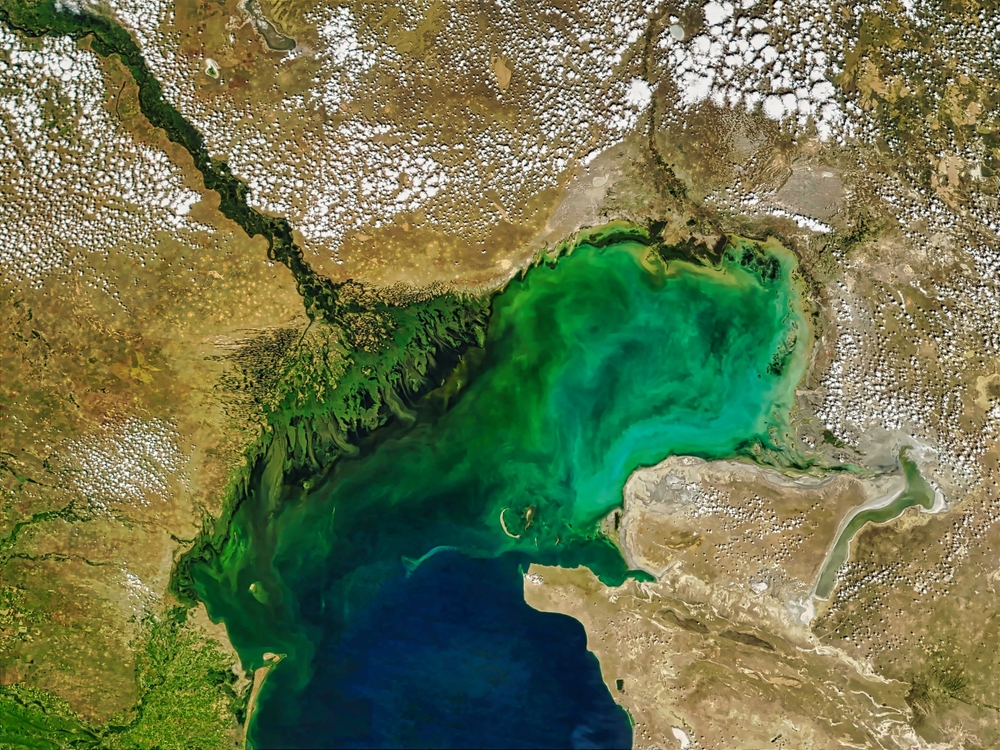
For over four years, Russia’s war on Ukraine has been fought largely through attritional means. Each side has targeted the other’s economic infrastructure to force capitulation. But as Ukrainian strike capabilities have grown in rage and precision, that campaign has exploded well beyond the two countries’ borders, reaching into the Caspian basin. Strikes on Russian oil rigs, sanctioned vessels, and the Caspian Pipeline Consortium have inflicted real costs on Kazakhstan, a country with no stake in the conflict. The war, in other words, has expanded beyond its original battlefield.
BACKGROUND: As of the second half of 2026, Russia’s full-scale-invasion of Ukraine has gone on for over 4 years, surpassing the length of the First World War. Though taking place over a century after the latter, the war in Ukraine shares many similarities, notably that they are both wars of attrition.
The Russian strategy of eroding Ukrainian resistance has come largely with strikes on Ukrainian energy infrastructure. Russia hopes that a steady deterioration and eventual collapse of the Ukrainian energy grid will push a situation where Ukraine would be forced to make peace on Russia’s terms. The Ukrainian strategy is similar in some regards but seeks to target the Russian economy as whole. While the Special Operations Forces (SOF), and Unmanned System Forces (USF) have systematically targeted Russian oil refineries, depots and occasionally energy production infrastructure, Ukraine has further gone on to target logistical warehouses, shipping lanes and other economic targets.
Ukraine’s campaign has been extensive, and has recently spread into the Caspian basin as Ukrainian capabilities grow. In December 2025, Ukrainian drones hit the Filanovsky and Korchagin oil rigs, part of Russia’s largest Caspian oil field, damaging equipment and suspending production. The attacks were not an exception, as multiple rounds of attempts were made at hitting the facility, demonstrating evidence of a sustained campaign and greater disruption.
Beyond attacking stationary targets like fuel depots and refineries, Ukraine has further gone on to strike sanctioned cargo vessels in the Caspian, and even a Russian missile boat. Then, in a dramatic move, Ukraine struck an Iran-linked vessel they claimed was carrying military equipment between Russia and Iran.
IMPLICATIONS: Ukraine’s campaign against Russia in the Caspian basin is evident, however the second order consequences of such attacks are just as important, as they not only affect the Russian economy, but the economies and security situations of all the countries in the Caspian.
Starting in February 2025, Ukrainian drones began targeting the Caspian Pipeline Consortium. The pipeline carries Caspian crude from the Tengiz oil field in Kazakhstan to the Novorossiysk-2 Marine Terminal, an export facility at the Russian Black Sea port of Novorossiysk and is hence economically important for both the Russian Federation and Kazakhstan. Though initially the attacks did not directly affect economic conditions outside of Russia, they have over time impacted Kazakhstan both financially and diplomatically.
The Caspian Pipeline Consortium has been struck repeatedly: in November 2025, January 2026, April 2026, and again in July 2026, with drones increasingly targeting the Novorossiysk-2 marine terminal’s loading equipment directly rather than the pipeline’s inland pumping stations. The January attack alone cost Kazakhstan an estimated US$ 1.5 billion, forced a roughly 6 percent cut to national oil production, and contributed to a 21.2 percent year-on-year decline in Kazakhstan’s oil export revenue in the first quarter of 2025.
Astana’s response has been both technical and diplomatic. Kazakhstan has formally protested that the strikes threaten global energy security, expedited the purchase of new mooring hardware to harden the Novorossiysk terminal against further damage, and, more consequentially, accelerated real cargo flows through the Baku-Tbilisi-Ceyhan pipeline as a working backup route rather than a hypothetical one. In effect, the drone campaign has done in months what years of Middle Corridor diplomacy had not: forced Kazakhstan to test how much of its alternative export capacity is actually usable under stress.
The results so far are small compared to the hope of what could be ultimately possible. KazTransOil moved around 700,000 tons of crude toward BTC through the port of Ataku in the first half of 2026, and state operator KazMunayGas has set a 2026 target of 1.7 million tons. This is a target that surpasses that of 2025 by 31 percent. However, these shipments are still a small fraction of the roughly 60 million tons Kazakhstan ships annually via Russian-linked routes.
Officials have floated the idea of eventually raising BTC volumes toward 20 million tons a year, though tanker capacity on the Caspian and the cost of blending heavier Kazakh crude to the pipeline’s Azeri Light specification remain binding constraints on how fast that can happen. Azerbaijan and Georgia separately revived the long-dormant Baku-Suspa pipeline in May 2026, and Kazakh officials have said they are discussing its use as a further outlet, though no formal proposal from Baku has been made as of now.
The Iranian dimension adds a second axis of risk. Tehran summoned Ukraine’s chargé d'affaires and issued a public protest to the EU after a strike on an Iranian-linked vessel killed a sailor, though regional analysts have largely read the strike as a demonstration of reach aimed at Russian-Iranian arms cooperation rather than the opening of a new front. That reading is complicated by an earlier Israeli strike on Iran’s Bandar Anzali port on the same sea, which has raised the possibility of Israeli-Ukrainian coordination. The Caspian is no longer a space where only one conflict’s logic applies, though it is unlikely the strike will escalate into anything larger.
The stakes extend beyond Russia and Kazakhstan bilaterally. Western oil majors, including Chevron and ExxonMobil, hold direct equity stakes in the Caspian Pipeline Consortium. This means disruption to the pipeline carries commercial consequences for U.S. and European firms, not just for Kazakh-Russian relations. This is a dynamic that a recent assessment ties directly to Ukraine’s parallel strikes on Russia’s Orenburg gas plant. Karachaganak’s gas is processed at Orenburg under a long-term supply contract, so when Ukrainian drones struck the plant in October 2025, and again in June 2026, Kazakhstan had to curtail gas intake there. Furthermore, because oil and gas condensate output at Karachaganak are tied together, oil production fell by roughly 25 to 30 percent each time. That reduced volumes directly for Chevron and Shell, which together hold a 47 percent stake in the Karachaganak consortium, making the field a second, non-CPC channel through which the war has hit Western-operated Kazakh production.
The Caspian strikes can be situated within that larger campaign: Ukrainian drone strikes have pushed Russian oil refining to a 24-year low, suggesting the Caspian theater is an extension of a broader economic-attrition strategy rather than an isolated escalation.
CONCLUSIONS: The Caspian basin is no longer insulated from the Russo-Ukrainian War. Kazakhstan is absorbing the bulk of these costs directly, but its neighbors’ exposure is more uneven than the corridor’s shared geography might suggest. Azerbaijan’s own Russia-linked route, the Baku-Novorossiysk pipeline, has for years run well below its roughly 5-million-ton annual capacity, more recently loading closer to 3 million tons of which roughly two-thirds is Kazakh. Baku at times had discussed reverse-flow arrangements to bring Russian oil south for domestic refining rather than depending on the line for its own exports, so its direct financial exposure to disruptions in the Caspian are limited. If anything, Azerbaijan and Georgia stand to gain. The two revived Baku-Supsa pipelines can, to the benefit of Baku and Tbilisi, capture Kazakh volumes diverted from CPC. Turkmenistan, whose exports do not run through the CPC/Novorossiysk corridor faces even less direct exposure.
Regional cooperation among Caspian states, and direct diplomatic engagement between Kyiv and Astana specifically, will matter for containing further spillover. However, Kazakhstan’s leverage to compel restraint from either belligerent is limited. What Astana can more plausibly control is its own exposure—to treat the diversification toward the Middle Corridor and Baku-Tbilisi-Ceyhan that the strikes have already forced in practice as an immediate operational priority.
AUTHOR’S BIO: Nicola Ilario is an undergraduate at the University of Pennsylvania. He studies Economics and History, with a concentration in the history of diplomacy. Nicola interned at the Central Asia-Caucasus Institute the Summer of 2026, assisting fellows in their research. He can be reached at This email address is being protected from spambots. You need JavaScript enabled to view it. .
By Giorgi Gvalia and Ivane Lomidze
Georgia’s deteriorating relations with the EU and the U.S. are commonly explained in two ways. One interpretation emphasizes domestic political survival, arguing that Georgian Dream increasingly views Western pressure for competitive elections, institutional constraints, and political accountability as a threat to its continued hold on power. The other stresses geopolitics: deeper alignment with Western policies toward Russia is seen as increasing Georgia’s exposure to retaliation, which the country lacks the security guarantees to withstand. These explanations are usually treated as alternatives. This piece argues instead that they reinforce one another. From Georgian Dream’s perspective, Western pressure can weaken the government politically and economically, while Russian coercion could destabilize both the state and the ruling party. Political survival and geopolitical caution therefore produce the same policy preference.

BACKGROUND:
Both Russia and the West can impose costs on Georgia’s government, but their instruments and potential consequences are fundamentally different. Western governments can use sanctions, diplomatic isolation, visa restrictions, political conditionality, and the suspension of assistance or institutional cooperation. They can also support civil society, independent media, and other institutions that constrain the ruling party’s political dominance.
Such pressure matters to Georgian Dream. Nevertheless, the government may view it as containable, and potentially reversible. Sanctions can be endured or partially circumvented. Diplomatic criticism can be presented domestically as unfair foreign interference. Political protests can be managed through administrative and coercive instruments. Georgian Dream may also expect that elections and changes of government in European capitals will eventually produce a more accommodating Western approach.
From the government’s perspective, Russia presents a different category of danger. It occupies Abkhazia and South Ossetia, maintains military forces on Georgian territory, and can escalate pressure with little warning. Moscow can employ military force, economic restrictions, incidents along occupation lines, political destabilization, or hybrid measures against which Georgia possesses limited defenses.
Most importantly, a confrontation with Russia would not threaten only Georgia as a state. It could also directly jeopardize Georgian Dream’s hold on power. A military crisis could generate additional territorial losses, economic disruption, displacement, public panic, and political instability. Even if the government survived the immediate confrontation, it could be blamed for provoking a conflict that Georgia had neither the resources nor the allies to win.
Political survival and state survival therefore become closely connected. A government principally concerned with remaining in office has powerful incentives to avoid military escalation, because a national-security catastrophe would almost inevitably become a political catastrophe.
Russia’s invasion of Ukraine heightened the salience of war and vulnerability in Georgian political debate. Georgian Dream used this context to justify restraint toward Moscow, repeatedly invoking the prospect of a “second front.” Rather than treating this claim as an established security assessment, its importance lies in how it has structured the government’s domestic narrative. Georgian Dream has associated its continued rule with peace and stability, while portraying opponents and Western critics as favoring policies that, in the government’s account, could increase Georgia’s exposure to conflict.
IMPLICATIONS:
This calculation helps explain why Georgian Dream may regard its present course as rational. From the government’s perspective, the relevant choice is not between the West and Russia, but between two different categories of risk.
This distinction explains why domestic political survival and geopolitical caution travel in the same direction. Avoiding confrontation with Russia protects Georgia from an immediate security threat, while simultaneously protecting Georgian Dream from the political consequences of a national crisis. Resisting Western pressure, meanwhile, allows the party to preserve its domestic position while signaling to Moscow that Georgia will not become an active participant in Western efforts to contain Russia.
Georgia’s expanding relations with China, Central Asia, Turkey, Azerbaijan and the Gulf states reinforce this calculation by creating the expectation that trade, investment, transit cooperation, and participation in the Middle Corridor can partially offset the economic and diplomatic costs of deteriorating relations with the West. If these ties cushion some of the costs of Western estrangement, resistance to Western pressure becomes more sustainable. From the government’s perspective, Georgia has no comparable means of offsetting the consequences of direct confrontation with Russia.
Moreover, Georgian Dream views these partnerships as politically less demanding because they are not accompanied by democratic conditionality associated with Western engagement. They also serve a domestic political function by allowing the government to argue that, despite tensions with Brussels and Washington, Georgia is not internationally isolated and continues to attract diplomatic engagement and economic partnerships. Unlike deeper integration with Western institutions, engagement with these actors is also not perceived by the government as likely to provoke Russian retaliation or coercion.
This perspective highlights that Georgian Dream’s foreign policy is shaped by its assessment of relative risks. Its policy can therefore be understood as asymmetric threat management. Georgian Dream accommodates the actor whose coercive power it cannot counter and confronts the actors whose pressure it believes it can survive.
However, the internal logic of this strategy does not eliminate its potential longer-term trade-offs. While it may reduce the risks Georgian Dream regards as most immediate, deteriorating relations with the West could gradually affect Georgia’s economic opportunities, institutional cooperation, international support, and capacity to respond to future Russian pressure. At the same time, continued accommodation could lead Moscow to expect further restraint from Tbilisi. A strategy aimed at minimizing immediate risks may therefore narrow Georgia’s external options over time, particularly if Russian pressure intensifies.
CONCLUSIONS:
Understanding Georgian Dream’s conduct requires attention to the hierarchy of risks underlying its decisions. Western political and economic pressure is unlikely to alter the government’s behavior as long as it is regarded as more manageable than the perceived consequences of antagonizing Russia. This does not imply abandoning political conditionality, but it suggests that Western policy must also address the security concerns that lead Georgian Dream to view accommodation with Russia as the least risky option for preserving peace and maintaining its domestic political position.
Ultimately, however, the internal logic of this strategy does not guarantee its long-term success. While Georgian Dream’s approach may insulate the ruling party from immediate political and security crises, it risks hollowing out the state’s future capacity for independent action. By prioritizing short-term threat management over deep institutional integration with the West, Georgia may find its strategic options increasingly narrowed. Over time, the erosion of Western support and the accumulation of Russian expectations could leave the country more isolated and vulnerable to the very coercion the government’s policy seeks to manage. The ‘rationality’ of this calculus may therefore provide immediate political survival at the cost of long-term strategic resilience.
AUTHOR’S BIO:
Giorgi Gvalia is Professor of International Relations and Jean Monnet Chair at Ilia State University in Tbilisi, specializing in small-state foreign policy, Realist IR theory, and South Caucasus geopolitics.
Ivane Lomidze is Associate Professor of Sociology at Ilia State University, whose work focuses on the normative and theoretical foundations of political realism.
By Bruno S. Sergi and Alimnazar Islamkulov
Uzbekistan's long-term competitive advantage will depend less on geography, natural resources, or low-cost labor and increasingly on its ability to develop, attract, and retain talent. The country has made significant progress through market reforms, digitalization, startup development, and international higher education partnerships. The emergence of firms such as Uzum and the growth of IT Park Uzbekistan demonstrate rising international confidence in the country's innovation potential. However, sustainable success will depend on building stronger institutions, deepening university-industry collaboration, and converting educational investments into innovation, research, entrepreneurship, and high-value economic activity.

BACKGROUND:
Two years after becoming Uzbekistan's first technology unicorn, Uzum established a $2.3 billion pre-money valuation reference point through a strategic investment of more than $130 million announced in March 2026 and led by sovereign entities of the Sultanate of Oman, with participation from existing investors including Tencent, VR Capital, and FinSight Ventures. The transaction may be interpreted as evidence of increasing international interest in Uzbekistan's digital economy and demonstrated that technology companies originating in Central Asia can attract significant global capital.
More broadly, it signaled the emergence of a new competition across Asia and beyond: the race to form, attract, and retain talent.
In an era when economic power is increasingly defined by innovation, technology, and human capital, competitive advantage is changing. Uzbekistan is transforming from an economy shaped by historic trade routes into a modern hub for entrepreneurship, digital innovation, and high-value industries. Uzbekistan, one of only two doubly landlocked countries in the world, along with Liechtenstein, sits at the crossroads of historic trade routes.
Yet with a population of more than 37 million and one of the youngest demographics in Eurasia, with more than half its citizens under 30, its relatively young population may provide advantages that some aging economies currently face difficulty replicating: a large and growing talent pipeline, if education, skills development and employment opportunities can keep pace. The question is whether Uzbekistan can evolve from a transit corridor and source of raw materials into a hub of innovation, intellectual property and high-value industry.
While geography still matters, institutions, connectivity, and human capital matter more. The global economy increasingly rewards capability, innovation, and specialized skills alongside traditional cost advantages. Cheap labor once attracted foreign investment, but today's investors seek skilled software engineers, founders, researchers, and professionals who can create sophisticated products and services.
Over the past several years, Uzbekistan has pursued reforms to open markets, digitize public services, encourage entrepreneurship, expand international partnerships, and invest in infrastructure. But the country should remain cautious. Startup rankings can rise fast, and a handful of successful firms does not automatically create an innovation economy.
This issue is critical because demographic advantages alone do not guarantee economic transformation. Uzbekistan's ability to capitalize on its young population will determine whether it can sustain growth, attract investment, diversify beyond traditional sectors, and compete in a global economy increasingly driven by knowledge, research, innovation, and technology-intensive industries.
IMPLICATIONS:
StartupBlink's recent rankings have highlighted Uzbekistan's growing position among emerging startup ecosystems. Hundreds of startups now operate across fintech, e-commerce, artificial intelligence, logistics, and digital services. The emergence of the country's first technology unicorn suggests that some domestic firms are beginning to demonstrate the capacity to compete beyond regional markets.
Challenges remain. A critical question is whether Uzbekistan is building the foundations of a sustainable innovation ecosystem. One place to look for answers is IT Park Uzbekistan, which has become one of Central Asia's most active technology ecosystems. Its rapid growth includes an expanding base of export-oriented firms, foreign-invested enterprises, and international technology companies. Importantly, this expansion is no longer concentrated in Tashkent. Foreign and export-focused firms are increasingly establishing operations across Uzbekistan's regions, broadening the geographic reach of the country's digital economy.
The challenge extends beyond creating startups. It also involves fostering an environment where entrepreneurs can learn, build, fail, adapt, and try again. Competitive innovation ecosystems emerge when businesses, universities, and policymakers work together to support experimentation and long-term growth. International experience suggests that such ecosystems perform best when talented individuals can build careers and companies locally while remaining connected to global markets.
Global competitiveness is increasingly defined by a different set of factors than in the past. Cheap labor and tax incentives once played a decisive role in attracting investment. Today, investors are drawn to locations that combine human capital, institutional quality, and innovation capacity. Companies increasingly choose destinations where they can find the skilled engineers, researchers, and entrepreneurs needed to develop products and services for global markets.
In Uzbekistan, a critical question is whether the foundations are being laid to shift policy priorities from incentives and subsidies toward stronger institutions, particularly within higher education. Uzbekistan has emerged as one of the world's largest hosts of international branch campuses, ranking behind only China and the United Arab Emirates. At the same time, the country's higher education system has expanded rapidly, while partnerships with international universities have created a more globally connected academic environment.
This expansion matters for reasons that go far beyond enrollment figures. Universities are among the primary mechanisms through which demographic potential is transformed into technical expertise, research capacity, and entrepreneurial talent. They produce the engineers, economists, scientists, managers, and innovators that domestic firms and multinational investors increasingly compete to recruit.
The next stage of Uzbekistan's transformation should therefore focus not only on expanding access to higher education but also on redefining the role of universities within the economy. Higher education institutions should become more active contributors to innovation, applied research, entrepreneurship, and regional development.
The true measure of progress will not be the number of universities operating in the country or the volume of graduates entering the labor market. Rather, it will be the extent to which knowledge and skills are translated into new technologies, productive firms, stronger institutions, more effective public policies, and practical solutions to economic and social challenges.
Achieving this outcome requires deeper collaboration between universities and industry. Research agendas should be more closely aligned with real economic needs, businesses should have stronger incentives to engage with researchers, and students should have greater opportunities to participate in entrepreneurship, internships, applied research, and international projects. Policymakers deciding where to invest the next phase of reform should therefore view university quality, research capacity, and knowledge transfer as essential components of innovation infrastructure, alongside support for startups and investment attraction.
According to C-BERT data, Uzbekistan ranks among the world's leading hosts of international branch campuses, with 32 foreign universities operating among its 207 higher education institutions. Campuses affiliated with institutions from Russia, South Korea, the UK, the U.S., Singapore, Japan, India, and other countries have contributed to the internationalization of the country's higher education sector.
International campuses have helped create a globally connected academic environment and Uzbekistan continues to expand its international education footprint. The government plans to attract branches of top-100 global universities and in July 2026, a proposal was presented to the president for a dedicated International University Campus in Tashkent, modeled on Qatar’s Education City and South Korea’s Incheon Global Campus.
The implications of these developments extend well beyond education policy. Universities that become stronger centers of research, entrepreneurship, and applied innovation can contribute directly to economic diversification and technological upgrading. More effective university-industry linkages can accelerate research commercialization, improve workforce quality, support startup creation, and strengthen Uzbekistan's attractiveness to foreign investors seeking access to skilled talent.
Yet educational expansion alone will not guarantee economic transformation. Without parallel improvements in institutional quality, research capacity, and labor market opportunities, the country risks underutilizing its graduates' skills. Such an outcome could accelerate brain drain and reduce the long-term returns on public investment in higher education. Ultimately, the future of Uzbekistan's innovation economy will rely not only on the number of startups it fosters and the universities it supports but also on its ability to transform educational and technological resources into globally competitive companies, groundbreaking institutions, and sustainable economic opportunities.
CONCLUSIONS:
A more meaningful way to measure progress might be the degree to which knowledge and skills are transformed into new technologies, innovative businesses, and strengthened institutions. It is about how effectively these insights and abilities lead to technological advances, the creation of productive enterprises, improved governance, sound public policies, and practical solutions to economic and social challenges. Achieving this will require much closer collaboration between universities and industry. Policymakers considering the next phase of reforms should pay more attention to research excellence and university capacity, which may strengthen broader innovation objectives. They should view research excellence and university capacity, alongside support for startups, as essential innovation infrastructure.
The next phase of reform should therefore focus not only on widening access to higher education, but also on repositioning universities as engines of innovation, applied research, entrepreneurship and regional development.
Overall, Uzbekistan's experience reflects a broader global shift in which human capital has become a primary source of national competitiveness. The country's youthful population, expanding technology sector, growing startup ecosystem, and extensive network of international higher education partnerships create conditions that could support future growth. Yet sustaining momentum will require continued attention to institutional quality, talent retention, research capacity, and innovation-driven development. If these elements are successfully integrated, Uzbekistan will be better positioned to evolve from a transit corridor and source of raw materials into a hub of innovation, intellectual property and high-value industry, strengthening both its economic resilience and international competitiveness.
AUTHOR’S BIO:
Bruno S. Sergi, PhD, is an instructor at Harvard University Division of Continuing Education and is affiliated with the Harvard Center for International Development, the Davis Center for Russian and Eurasian Studies, and the Harvard University Asia Center, and is a full professor at the University of Messina, Italy. His teaching includes development economics and the political economy of the Global South. He has led the launch of multiple scholarly journals and book series, including the Cambridge Elements series at Cambridge University Press and Entrepreneurship and Global Economic Growth at Emerald Publishing.
Prof. Dr. Alimnazar Islamkulov is Director of the Transformation Center at Tashkent State University of Economics, Uzbekistan. His research focuses on public finance, tax policy, intergovernmental fiscal relations, and regional development. He has served as a judge for the QS Reimagine Education Awards and contributes to international academic cooperation, university accreditation, and higher education reform across Central Asia and beyond.
Feature Articles
|
Earlier Articles
|




The Central Asia-Caucasus Analyst is a biweekly publication of the Central Asia-Caucasus Institute & Silk Road Studies Program, a Joint Transatlantic Research and Policy Center affiliated with the American Foreign Policy Council, Washington DC., and the Institute for Security and Development Policy, Stockholm. For 15 years, the Analyst has brought cutting edge analysis of the region geared toward a practitioner audience.
Sign up for upcoming events, latest news, and articles from the CACI Analyst.