Kazakhstan's First Kurultai Under a New Constitution
By Erlan Benedis-Grab
On August 23, 2026, Kazakhstan elected its inaugural session of the state Kurultai, following its establishment under Kazakhstan's constitutional changes approved in the March 15 referendum. Adilet, the party into which the long-ruling Amanat (previously Nur Otan) merged, took 71.17 percent of the vote nationwide and 110 seats out of 145, a decisive supermajority. Kazakhstan's constitutional changes created the post of Vice President, a new People's Council, and the consolidation of the bicameral legislative branch into a unicameral parliament under a party list system. The overwhelming victory for the ruling party confirms what the constitutional changes made close to inevitable: an expanded presidential authority under President Kassym-Jomart Tokayev, in which he can wield the system for a variety of purposes.
BACKGROUND:
The process of constitutional reform began as a suggestion for parliamentary reform. In his state of the nation address on September 8, 2025, President Kassym-Jomart Tokayev proposed abolishing the Senate and moving to a unicameral chamber elected entirely by party list. The process accelerated in early 2026. In January, Tokayev announced his intention to reform Kazakhstan’s constitution, establishing a Commission on Constitutional Reform chaired by Constitutional Court head Elvira Azimova, with Tokayev’s top deputy Erlan Karin as deputy chair. In February, Tokayev signed a decree, setting the referendum for March 15th. In March, voters approved the new constitution with an overwhelming majority of 87.15 percent. In July, the constitution took effect, terminating the bicameral parliament and triggering elections to the Kurultai on August 23.
Previously, Kazakhstan had a bicameral parliament consisting of the Mazhilis and Senate. The changes consolidated the two into a new unicameral parliament, called the Kurultai (meaning “assembly” or “gathering” of Turkic leaders). Additionally, the new parliament is elected entirely from a party list, replacing the previous mixed system of 70 percent party list and 30 percent single-member constituencies.
A new quasi-legislative consultative body, the Halyk Kenesi (People’s Council), has been established, combining the earlier People’s Assembly of Kazakhstan and the National Kurultai. It is supposed to be a technocratic body designed to develop policy recommendations from the public. It is composed of 126 members, directly appointed by the president. It has the power to prepare legislation for the Kurultai and propose nationwide referendums, yet its functional role is likely to be limited.
A vice presidency has also been created, with the vice president appointed by the president. This new position is first in the presidential line of succession, without necessarily making the vice president Tokayev’s successor.
The president will now nominate the Prime Minister, Supreme Court judges, and the Kurultai Speaker. Positions previously requiring Senate consent, including the heads of the Central Bank, the National Security Committee, and the Prosecutor General, now fall under presidential authority. These changes mark an institutional weakening of the parliament's authority.
The August 23 elections were the first contested by the Adilet (meaning justice) party, registered in June and led by Tokayev's former Chief of Staff, Aibek Dadebai. Following this, the ruling Amanat party, formerly Nur Otan, voted to merge itself into the Adilet party, making Adilet its successor as the ruling party of Kazakhstan.
With the apparatus of the Akorda clearly behind Adilet, it decisively captured 71.17 percent of the nationwide vote, taking roughly 110 of 145 seats. The OSCE commented that while the elections were orderly, they took place in an environment lacking political pluralism.
IMPLICATIONS:
Despite Tokayev’s promise of a “New Kazakhstan,” the constitutional changes affirm the dominance of Kazakhstan's super-presidential system. In this system, the president's formal powers so far exceed those of the legislature and the courts that no institution retains an effective check on him. The constitutional text now accommodates whatever Tokayev chooses to do with it, rather than constraining what he may do.
In his September 2025 address, Tokayev initially announced that reforms would take place in 2027. Instead, the whole rewriting process took around 6 months. Although Akorda framed it as a “broad nationwide discussion,” the constitutional text was likely engineered months or years before it was announced to the public. Given the rushed process, civil society in Kazakhstan, however limited, did not have enough time to mobilize significant opposition to the constitutional referendum.
Tokayev is 73, raising the question of succession. The position of the vice presidency can be construed as a post for Tokayev to test his successor, or to withdraw from the presidency incrementally.
However, even though Tokayev's presidential term ends in 2029, the Constitutional Court ruled that because the constitution was replaced outright rather than amended, terms served under the old charter do not count. Any election after the new text took effect counts as the first election. Kazakhstan’s single, non-renewable seven-year term remains untouched, but could carry Tokayev to 2036.
In appointing Erlan Karin as vice president, Tokayev chose someone whose political rise is tied to his own rule, rather than to the Nazarbayev-era patronage networks. Karin, a longtime presidential aide and former State Counselor, has been one of Tokayev’s most prominent political strategists. Yet the office could eventually offer Tokayev himself a post-presidential role. The obvious precedent is 2019, when Nazarbayev left the presidency but retained significant influence as Chairman of the Security Council. That way, Tokayev could wind down his leadership, passing the reins while securing his post-presidential position and retaining leverage.
Now, the elections to the Kurultai will be completely conducted through a closed party-list system, where the Adilet apparatus, and Akorda, handpicks their chosen candidates. Interestingly, this is a reversal of Tokayev’s own reforms submitted in 2022, mandating a 70/30 ratio for party-list vs single-seat constituencies. Its reversal signifies that Tokayev is past the early concessions of 2022, now rolling back the limited political reform of this period.
Neither system is entirely better or worse, but in Kazakhstan’s case this move clearly tightens presidential control over candidate selection. Candidates without the explicit support of the ruling Adilet party will be highly likely to be excluded from the new parliament.
Tokayev is also overhauling Kazakhstan's political machinery, merging Amanat with Adilet. Although Nur Otan was renamed Amanat in 2022, Tokayev wants a party that is unmistakably his own. Mazhilis MP Erlan Sariov put it succinctly, “Nazarbayev's fingerprints remain all over Amanat,” explaining why Tokayev would want a new party altogether. Yet there is no growth in pluralism, the party was molded from above rather than growing out of public demand. In truth, Tokayev gets a clean slate, a rebranded machine he can wield as he sees fit.
Turnout was reported at 74.08 percent, twenty points above the 54.21 percent of 2023. However, the OSCE noted “significant differences between voter activity observed and the official turnout data”. The election was contested by several parties: the agrarian Auyl, the perennial opposition Ak Zhol, the “modern” Respublica, the communist remnants of the People’s Party, and the “real” opposition Nationwide Social Democratic Party, but Adilet captured the majority vote. The manufactured nature of these parties and their general unwillingness to oppose the government’s line could not seriously pose a challenge.
CONCLUSIONS:
Akorda hopes to usher in a renewed Tokayev era with a new constitution, an updated parliament, and a decisive majority for the government, yet the core questions about Kazakhstan’s direction remain. Tokayev has reversed the chapter Kazakhstan opened during the turbulent year 2022 and the concessions then made by his government. The new constitution symbolizes that reversal; some changes are cosmetic, others engineer elite confidence in his rule. All of them empower him and the super-presidential system. Tokayev’s succession remains in question. The vice presidency can seat a successor, hold the chair for Tokayev himself, or stand by as he resets his own term, and the constitution now permits all three. Tokayev’s “New Kazakhstan” program may usher in increased modernization, efficiency and even transparency. It will not, however, undermine the dominance of the state. That approach may continue to bring prosperous autocratic development to Kazakhstan, but the public’s scorn over the lack of civic participation may build to a boiling point.
AUTHORS BIO:
Erlan Benedis-Grab is a Junior Fellow at the Central Asia-Caucasus Institute. He holds a dual B.A. in Economics and Central Eurasian Studies at Indiana University Bloomington, and his research focuses on Central Asia, International Trade, and Energy Politics. He can be reached at This email address is being protected from spambots. You need JavaScript enabled to view it. .
Uzbekistan’s Constitutional Referendum
By Farkhod Tolipov
June 14, 2023
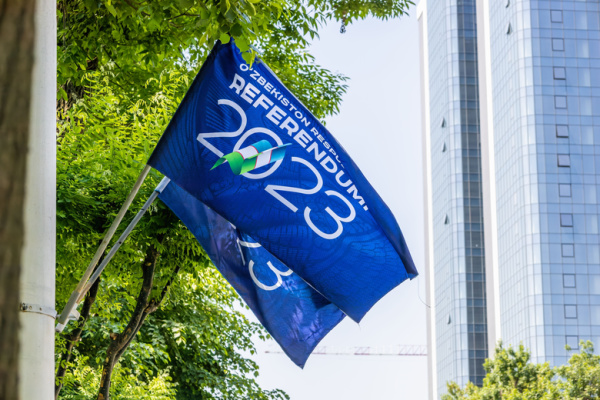
On April 30, 2023, Uzbekistan held a referendum on amendments to the country’s Constitution. The referendum was preceded by an ambitious propaganda campaign calling on people not to be indifferent and to actively participate in the referendum. However, the controversial text of the draft Constitution appeared to be worked out in closed cabinets of the Constitutional Commission without broader engagement of experts and civil society representatives. Loud propaganda, in the spirit of Soviet tradition, contrasted with the silence of ordinary citizens and their very low level of awareness of the content of the document subjected to the vote.
Kyrgyzstan to Hold Another Constitutional Referendum
By Arslan Sabyrbekov (05/13/2015 issue of the CACI Analyst)
On May 5, Kyrgyzstan marked the 22nd anniversary of its constitution. In a relatively short period, the country’s basic law went through numerous changes, with the state remaining inefficient. The changes primarily aimed to centralize and strengthen the vertical of power of the first two ousted Presidents. Kyrgyzstan’s current constitution, adopted via a nationwide referendum in the aftermath of the April 2010, has been an exception. Ye the country’s prominent political circles recently suggested holding another referendum in the fall, together with the parliamentary elections.
Kyrgyzstan’s first constitution as an independent state was adopted in 1993 after two years of heated debates in the country’s “legendary Parliament,” as it was termed at the time. Already in 1994 the constitution faced new amendments, under the slogan of creating two chambers of the Parliament, but in reality massively increasing the power of the country’s first President Askar Akaev. A series of amendments were again introduced in 1996, 1998 and 2007 under the reign of the country’s second President Kurmanbek Bakiev, who just like his predecessor, was keen to manipulate the basic law to increase the authority of his own regime.
In 2010, Kyrgyzstan did what then seemed to be unthinkable in Central Asia by adopting a constitution that limited the power of the head of state, in a region where personalization of power is the rule. Moreover, with the objective of preventing further manipulation and ensuring a form of stability to the new system, a Constitutional council comprised of 75 members decided to introduce a special clause, banning any changes to the basic law until 2020. After less than five years, the country’s power holders are again eager to change it.
The talks on amending the 2010 constitution were activated a year ago, with some politicians advocating it from time to time. During a meeting of the country’s Council on Judicial Reform last October, President Atambayev also supported the idea of changing certain articles in the constitution, as he put it, “if they are necessary to carry out full-fledged reform of the judicial sector.” Without much subsequent public deliberation ever since, the initiators have presented a new set of amendments on April 28, stirring heated discussion and opposition from expert and civil society circles.
According to local political experts, the initiatives severely weaken the independence of parliamentarians. Under the proposed amendment, parliamentary factions can vote for early termination of the duties of individual MPs, if so proposed by the governing body of their respective political party. The initiators of the change justify this amendment, arguing that voters vote for a party rather than individual candidates. Yet according to political analyst Tamerlan Ibraimov, “in the Kyrgyz political context, voters first look at the individuals who are in the party list and then decide which party to vote for. The amendment is simply an effort to establish a system of party dictatorship and will not increase the efficiency of the legislature whatsoever, as claimed by its initiators.”
Moreover, the proposed changes strengthen the role of the Prime Minister. He will be in a position to dismiss members of the government and directly appoint and dismiss heads of regional administrations, therefore clearly weakening the role and independence of local self-governments. This initiative has already led to speculations that it serves the interests of the current President, who could after his term in office become the country’s next Prime Minister with extensive powers and no term limits, in close resemblance of the Kremlin scenario. Under the country’s current constitution, the president serves one six-year term with no possibility for reelection. President Atambayev’s term in office expires already in 2017.
Whatever the real motives are, a new amendment to the constitution will hardly improve pluralism in Kyrgyzstan’s political life. Instead, it will strengthen the “vertical of power” and will gradually diminish the room for political competition, along with general legal culture. In more than two decades of independence, the country’s political elite has become accustomed to blaming the constitution for their own lack of capacity to launch public reforms. Therefore, the real problem lies not with the constitution, but with the unwillingness of the power holders to abide by it and their constant efforts to redraw it for their own benefit.
Kyrgyzstan Debates Constitutional Change
By Arslan Sabyrbekov (10/29/2014 issue of the CACI Analyst)
Initiatives to amend Kyrgyzstan’s constitution, adopted in the aftermath of the April 2010 events and transforming the country into the first semi-parliamentarian state in Central Asia, are again on the rise. In the past month, a number of prominent politicians have made statements ranging from proposing additional amendments to completely changing the constitution. During last week’s meeting of the Council on Judicial Reform, Kyrgyzstan’s President Almazbek Atambayev also supported the idea of changing certain articles in the constitution, “if they are necessary to carry out full-fledged reform of the judicial sector.”
This fall, two members of parliament have expressed their desire to launch constitutional amendments. The first initiative group led by MP Felix Kulov, leader of the Ar-Namys party, proposed removing the suffix “stan” and adding an “el” in the country’s name through a nationwide referendum. According to him, the resulting “Kyrgyz El Republic” would make use of the Turkic-origin “el,” that means “nation” in Kyrgyz. Kulov’s proposal received varying judgments, ranging from the party leader’s desire to attract public attention ahead of the upcoming parliamentary elections to his attempt of drawing support from the so-called “national-patriotic groups.”
According to Atyr Abdrahmatova, leader of the civic union For Reforms and Results, Kulov’s proposal has little to do with changing the name of the country. Instead, Abdrahmatova claims that the suggestion was simply a pretext for probing how the Kyrgyz public would react to the idea of amending the constitution through yet another referendum. If the public agrees to such a proposal, the country’s political forces could then add additional questions to the agenda of the referendum, such as for example a different power redistribution between the President, Government and Parliament. This would indeed bring Kyrgyzstan back to the times of the first two ousted Presidents, when the country’s constitution was changed numerous times in favor of one office, turning it into a constant subject of political bargaining between the stakeholders.
Kyrgyzstan’s current constitution, adopted in June 2010, contains a special clause banning any constitutional changes until 2020. This provision was introduced in order to ensure some measure of stability to the country’s semi-parliamentarian form of government that the new constitution introduced. But last month, MP Karganbek Samakov, who has recently left the Ata Meken faction, issued a draft law repealing the ban. In his words, the “constitution is a living and moving body and it needs to be changed when necessary. Especially now, some of its rules are often violated, are not always enforced and are contradictory in their content.” These initiatives of parliamentarians and the President’s readiness to discuss constitutional amendments are obviously not coincidental and prepare the ground for the next possible modification of the country’s constitution.
Local experts skeptically perceive the president’s apparent willingness to change the constitution as a means for conducting judiciary reform and instead suspect that he maneuvers to remain in office beyond his current term. According to political scientist Uran Botobekov, the President might be preparing to run for reelection in 2017, which is not possible under the current constitution. However, in his address to the Council on Judicial Reform last week, President Atambayev clearly stated that he has no intention to change the country’s constitution in his favor as his predecessors did and will not become an authoritarian leader. Time will show if words will be kept.
Indeed, it is questionable whether adding a presidium to the Supreme Court by launching a nationwide referendum will result in any effective reforms of the judicial branch, which remains dependent on the will of political actors. The recent release of former politicians accused of heavy corruption deals speak in favor of this judgment. The country’s political elite commonly blames the constitution for their inability or lack of political will to conduct meaningful reforms. This constitution adopted only four years ago is unlikely to pose an exception. After more than two decades of independence, Kyrgyzstan is still engaged in a debate over choosing the most suitable system of governance.
The author writes in his personal capacity. The views expressed are his own and do not represent the views of the organization for which he works.
Visit also