Central Asian States and the Bagram Dilemma
By Aleksandar Ivanović
During a joint press conference with British Prime Minister Keir Starmer in September, U.S. President Donald Trump expressed interest in retaking the Bagram Airbase in Afghanistan, citing concerns about monitoring China’s nuclear program. The statement drew immediate opposition from the Taliban and China, while placing Central Asian states in an uncomfortable diplomatic position. The region’s governments must now balance their growing economic partnerships with Taliban-run Afghanistan against potential benefits from renewed U.S. engagement, while maintaining critical relationships with Russia and China.
Credit: Get Archives
BACKGROUND: Ever since retaking office in January, Donald Trump’s stance on Afghanistan has been quite clear. The idea of a U.S. presence in the country has quickly faded away since the turbulent withdrawal, for which Trump has publicly expressed his frustration. He criticized it for multiple reasons, partly fueled by his ideological differences with President Joe Biden, as well as concerning the handling of the situation, at times suggesting it should never have happened at all. His recent confrontational attitude turn the spotlight back to the now Taliban-run state, triggering a multitude of responses from regional actors, including open condemnations from the Taliban itself and China.
The Taliban’s Chief of Staff at its Defense Ministry, Fasihuddin Fitrat, has publicly opposed any military intervention in Afghanistan and expressed shortly after Trump’s statements that “ceding even an inch of our soil is out of the question and impossible.” However, according to the White House, the ambitions towards Bagram are driven less by Taliban-run Afghanistan than by a strategic effort to monitor China.
The airbase was first built in the 1950s by the Soviet Union and redeveloped in 2001 following the U.S.-led invasion. It is located 40 miles north of Kabul, and is, according to Trump, close to where China “makes its nuclear weapons.” The closest nuclear weapons test site in China is in Lop Nur, in the Xinjiang region of northwestern China, 1,200 miles from Bagram. The last nuclear test was conducted in 1996; however, recent satellite images have shown probable test-related preparation at the site since 2019, including newly graded access roads in the historic test area.
China has openly expressed its opinion regarding intervention, offering harsh opposition to the U.S. proposal. Foreign ministry spokesperson Lian Jian stated that China respects Afghanistan’s independence, sovereignty, and territorial integrity. Reports have also uncovered that Beijing invited the Taliban’s Defense Minister, Mulla Yaqub Mujahid, for a visit.
IMPLICATIONS: The tense clash in opinions over Bagram has left Central Asian countries, Afghanistan’s northern neighbors, in a complex position. The five states initially hinted at opposition to Trump’s efforts, shown in a joint statement of the Moscow Format of Consultations on Afghanistan, reaffirming their “unwavering support for the establishment of Afghanistan as an independent, united, and peaceful state” and deeming unacceptable “the attempts by countries to deploy their military infrastructure in Afghanistan and neighboring states, since this does not serve the interests of regional peace and stability.”
Central Asian governments have also stressed cooperation with Taliban-run Afghanistan in the past few years, with partnerships that have demonstrated significant resilience and evolution, a dramatic pivot from some initial opposition after the 2021 takeover. The Kazakh-proposed UN Almaty Centre is a notable testimony that became a reality in August. It aims to connect Central Asian governments, UN country teams, the private sector, and regional organizations to foster further initiatives in Afghanistan regarding humanitarian efforts and human rights issues. Kazakhstan and Uzbekistan also each expect to conduct US$ 3 billion worth of trade with Afghanistan in 2025 in hopes of fostering regional cooperation and improve the country’s poor economic indicators, which instigate external security challenges like extremism. Supporting a U.S. seizure of Bagram airbase could therefore damage the economic potential of their direct neighbor, which also harbors extreme security threats.
Recent developments between Russia, China, and Afghanistan have added another dimension to the race for investing in Afghanistan, and Central Asian support for a U.S. military intervention would derail their efforts to compete with the main economic and political actors in the region. The issue also contributes to an uneasy diplomatic situation between them and their two largest and most reliable trading partners. China has accelerated infrastructure investments in Afghanistan, including its copper mining project at Mes Aynak, potentially the world’s second-largest copper deposit. Russia formally recognized the Taliban government in July 2025, becoming the first country to do so and facilitating a path for future diplomatic partnerships.
Russia and China have also proven to be more reliable and consistent partners to Central Asian governments than the U.S., which has pivoted its policy in the region on multiple occasions, shifting from joint military initiatives after 9/11, to reduced attention the following decade, to the present effort to revitalize relations. Central Asian states have responded cautiously while simultaneously cooperating with Russia and China.
Siding with regional powers and acknowledging Afghanistan’s territorial integrity is clearly the safest option for these states. However, the White House’s latest gambits, recent trade deals, and U.S. military capabilities could incentivize a shift in their position. Central Asia could access diversified investment opportunities, offering a rare moment to collaborate with the U.S. and change the Western perception surrounding this region. Washington has already helped set this scenario, in recent years paying special attention to Central Asia, a region that was expected to be at the bottom of U.S. priorities since the disengagement with Afghanistan.
Trump has praised Central Asian leaders, writing about Uzbek President Shavkat Mirziyoyev and Kazakh President Kassym-Jomart Tokayev on his social media accounts. This year, he endorsed a US$ 8 billion deal for Uzbekistan to buy Boeing 787 Dreamliners. President Mirziyoyev later announced other agreements with U.S. firms covering mining, energy, and transport. Similarly, Washington embraced a deal with President Tokayev concerning US$ 4.2 billion worth of freight railroad equipment. Tokayev also held talks at the UN General Assembly with U.S. officials and corporate executives. These economic deals, along with continued U.S. interest in the Middle Corridor, an economic priority for the region, may reorient Central Asia’s stance on the airbase dilemma.
Another benefit is that the Bagram Airbase can potentially serve as a place for shared anti-terrorism intelligence. Central Asia has been plagued by extremist challenges originating from Afghanistan in the past, most notably from ISIS-K, an Islamic State branch that recruits non-Pashtun minority ethnic groups living in the northern region of Afghanistan, like Uzbeks and Tajiks. ISIS-K also includes radicalized extremists from Central Asia, who oppose their home governments in Tajikistan and Uzbekistan and travel to Afghanistan to become fighters. Despite being their number one adversary, the Taliban government has failed to suppress ISIS-K attacks in the region, which have continued since the U.S. departure. One example includes the alleged missile attacks in 2022 near the Uzbek border, which the Taliban openly condemned but failed to prevent. A U.S. presence in Afghanistan can provide new capabilities for combating Afghan security challenges, unavailable to the Taliban and other external powers. These could build on past initiatives, which included U.S. funding of training for Tajik border forces and strategic drone strikes on ISIS-K members in Nangarhar, Afghanistan’s eastern province.
CONCLUSIONS: Central Asia has for now collectively taken a conservative route. They refrain from initiatives that could jeopardize relations with their large and reliable trade partners or the already progressive efforts to rebuild Afghanistan. On a global scale, the region’s economic potential is still emerging, and the regional states seek to build economic relations with multiple external actors to stay on a steady path of economic growth.
The specifics of the Trump administration’s approach towards the Bagram Airbase are also unknown and fraught with significant risks. There are currently no guarantees that this objective is attainable, that it will ensure effective monitoring of China’s nuclear program, or that it will not trigger further conflict. These concerns heavily undermine the credibility of Trump’s statements on the matter, and the lack of official discussions with the Department of Defense or formal endorsements from Congress currently makes a U.S. attempt to retake Bagram highly unlikely.
This could change, however, and a potential takeover of the Bagram Airbase in the future will likely offset Central Asia’s steady economic and political trajectory, which builds on multiple partners. For now, they have decided to lay low and continue focusing on existing economic and security efforts.
AUTHOR’S BIO: Aleksandar Ivanović is a researcher at the American Foreign Policy Council Email:
This email address is being protected from spambots. You need JavaScript enabled to view it.
.
Brokers on the Bloc: Central Asian Alignment Through Collective Security
By John DiPirro
Russia’s diminishing influence in the South Caucasus, highlighted by the nascent Azerbaijan-Armenia rapprochement, has opened political and security space for new actors to shape the regional order not just in the South Caucasus, but across Eurasia—including, most notably, in Central Asia. Türkiye’s expanding military-industrial presence and institutional influence give it the unique opportunity to develop a strong relationship with the Central Asian states. But it cannot do so alone. Azerbaijan, positioned between Türkiye and Central Asia, can serve as a bridge between the two, translating Turkish capacity into Central Asian contexts.

Security Concerns Impede China-Pakistan Relations
By Ghulam Ali
Chinese Ambassador to Pakistan Jiang Zaidong recently criticized the repeated attacks on Chinese nationals in Pakistan, calling them “unacceptable” and citing security as the biggest challenge to the China-Pakistan Economic Corridor (CPEC). His comments followed two fatal incidents within six months, which claimed seven Chinese lives. Pakistan’s Foreign Office, instead of addressing the concerns, dismissed the remarks as “perplexing,” revealing underlying tensions in the bilateral relationship. Despite China’s role as Pakistan’s key economic partner, security lapses and strained diplomacy are testing the limits of their traditionally strong ties, highlighting deeper challenges to the CPEC and broader cooperation. These tensions point to a more complex dynamic in bilateral relations, revealing that mutual dependency alone may not be sufficient to sustain smooth cooperation amidst mounting challenges.

BACKGROUND: The diplomatic row between China and Pakistan intensified during a seminar in Islamabad on October 30, when Chinese Ambassador Jiang Zaidong openly rebutted remarks by Pakistan’s Deputy Prime Minister and Foreign Minister Ishaq Dar. Dar claimed that China prioritized security in its overseas investments but made Pakistan an exception due to its friendship. The ambassador firmly countered, stating that President Xi Jinping consistently emphasizes the importance of ensuring the safety of Chinese personnel, institutions, and projects in Pakistan, reiterating that security remains China’s top concern and a major constraint to the CPEC. This marked the first public expression of such sentiments by China and an equally unprecedented response from Pakistan's Foreign Office, which described the remarks as “perplexing” and “surprising.” Pakistan's English-language media reflected the gravity of the situation, with Dawn describing the exchange as rare and The Nation advising restraint from the Foreign Office. Further complicating matters, Pakistan canceled President Asif Ali Zardari’s planned visit to China on November 2, citing a dubious pretext of a foot injury, signaling deeper strains in the relationship amid growing concerns over security and diplomatic discord. This is not the first time China has urged Pakistan to ensure the security of its nationals. In several meetings with Pakistani leaders, China has consistently emphasized the importance of safeguarding Chinese citizens and interests in Pakistan. During his meeting with Pakistani Prime Minister Shahbaz Sharif in June 2024, Chinese President Xi Jinping reiterated the need for Pakistan to create a safe and stable environment, stressing the protection of Chinese nationals, projects, and institutions. In line with this, Beijing also sent Liu Jianchao, Minister of the International Department of the CPC Central Committee, to Islamabad, where he echoed similar concerns regarding security during discussions with Pakistan’s political leaders. China has faced numerous attacks on its citizens in Pakistan, with over 21 Chinese nationals killed since 2017. The Balochistan Liberation Army, a separatist group seeking independence for the underdeveloped Balochistan province, which hosts the strategic Gwadar Port, is behind many of these attacks. The Balochi population has long expressed grievances over marginalization and resource extraction without benefiting from the region’s wealth, fueling insurgent movements. Currently, Balochistan is experiencing its fifth wave of insurgency. Another key source of attacks on Chinese nationals is the Tehrik-i-Taliban Pakistan (TTP), a militant group primarily based in Khyber Pakhtunkhwa and along the Pakistan-Afghanistan border. While the TTP has denied responsibility, Pakistani authorities have attributed the March 2024 suicide bombing that killed five Chinese engineers to the group. Allegations suggest that the TTP may be collaborating with Uyghur separatists, given their shared religious ideology, further complicating the security landscape for Chinese nationals in Pakistan.
IMPLICATIONS: The Chinese ambassador’s public expression of frustration and his direct reprimand of Pakistani officials highlighted China’s increasing impatience with Pakistan’s handling of security for Chinese nationals. By emphasizing the gravity of the situation and warning against future incidents, the ambassador signaled that China would no longer shy away from bluntly addressing its concerns. This shift in tone underscores the growing tension in the bilateral relationship, with the potential for global attention if the situation deteriorates further. The security situation in Pakistan will be pivotal in determining China’s future investment decisions. If the security environment remains unstable, China may choose to complete ongoing projects but refrain from launching new ones. This was evident during Chinese Premier Li Qiang's mid-October visit to Pakistan for the SCO conference, where he did not explicitly endorse the second phase of the CPEC or any new initiatives. This lack of commitment signals that security concerns could heavily influence China’s willingness to deepen its involvement in Pakistan moving forward. China and Pakistan had already planned to review their counterterrorism cooperation, and recent developments are likely to expedite this process through three key trends. First, China may increase its security support by providing bomb-proof vehicles for the safe transport of Chinese engineers, offering specialized security training to Pakistani personnel, and expanding intelligence sharing and consultation between the two countries. Second, the idea of involving Chinese private security companies (PSCs) or establishing joint security arrangements with Pakistani counterparts could gain traction. China has expressed interest in deploying PSCs, especially in conflict zones worldwide, to safeguard its growing investments. However, the deployment of PSCs to Pakistan faces both legal and practical obstacles. Pakistani law prohibits foreign security companies from operating within its borders. Even if this hurdle is overcome, the concept is likely to face challenges due to the country’s security realities. The Pakistani military and intelligence agencies, despite having the necessary resources and capabilities, have struggled to protect Chinese nationals. Given this, private companies, with far fewer resources, may not be effective in improving security. Additionally, bringing in foreign security personnel, whether from China’s armed forces or private firms, could expose them to the same risks from terrorist groups that have targeted Chinese nationals in the past. Third, the worsening security situation in Pakistan could provide the military with a pretext for launching another large-scale military operation, something it has long advocated. In June 2024, the Pakistani government approved the counter-terrorism operation Azm-e-Istehkam (Resolve for Stability), but its implementation was delayed due to opposition from political parties and the Pashtun Tahafuz Movement (PTM), which advocates for the rights of Pashtuns. However, conducting a military operation during a period of economic difficulties, political polarization, and significant opposition would reduce its likelihood of success. Additionally, such an operation would come with substantial economic costs and the risk of collateral damage, particularly in already unstable regions, further complicating its execution and effectiveness.
CONCLUSIONS: Although a seemingly minor incident, Chinese Ambassador Jiang Zaidong's remarks have exposed long-standing issues between China and Pakistan, revealing underlying challenges in their relationship. These comments have sparked debate, both within Pakistan and internationally, regarding the durability of their "all-weather" friendship. If one factor has most damaged the Sino-Pakistani partnership, it is terrorism. Likewise, if there is one issue that will significantly determine the future of this relationship, it is the ongoing challenge of terrorism and its impact on security for both nations.
AUTHOR’S BIO: Dr. Ghulam Ali is the Deputy Director of the Hong Kong Research Center for Asian Studies (www.rcas.top). He received his PhD from Monash University in Australia and completed a postdoc at Peking University in Beijing. He has authored or edited four books and published articles in academic journals and media outlets.
Security and Military Cooperation Among the Turkic States in the 2020s
Richard Outzen
December 8, 2023
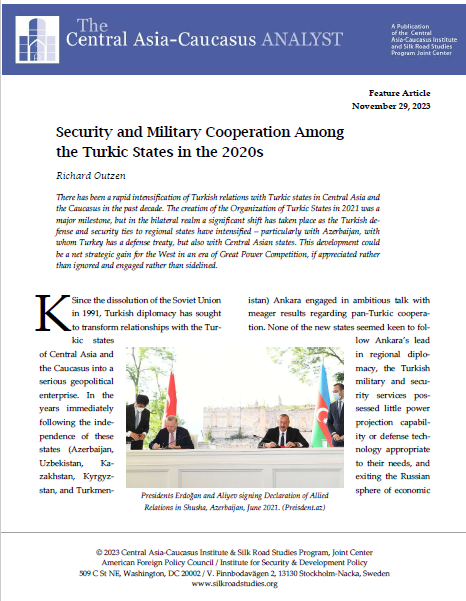
There has been a rapid intensification of Turkish relations with Turkic states in Central Asia and the Caucasus in the past decade. The creation of the Organization of Turkic States in 2021 was a major milestone, but in the bilateral realm a significant shift has taken place as the Turkish defense and security ties to regional states have intensified – particularly with Azerbaijan, with whom Turkey has a defense treaty, but also with Central Asian states. This development could be a net strategic gain for the West in an era of Great Power Competition, if appreciated rather than ignored and engaged rather than sidelined.
Protecting BRI: China's Foreign Security Concerns
By Sudha Ramachandran
March 14, 2019, the CACI Analyst
In November 2018, Baluch militants, angry with China’s exploitation of their resources through Belt and Road Initiative (BRI) projects, attacked the Chinese consulate in Karachi, Pakistan. This underscored the vulnerability of Chinese nationals and infrastructure projects outside China’s borders to terrorism. In addition, China’s repression of Muslim Uighurs in its Xinjiang province has drawn the ire of Uighur militants and jihadist groups. China will have to find a way to secure its nationals abroad and projects in BRI member-states, without triggering alarm among BRI skeptics.
Visit also