By: Sobir Kurbanov and Eldaniz Gusseinov
The renewed closure of the Strait of Hormuz, which followed the strikes on Iran of 28 February 2026, has tested world energy markets without producing the price spike that most forecasters expected, and the main reason lies in China. Chinese crude imports fell to 7.1 million barrels per day in June against a 2025 average of 11.6 million, while refinery utilisation dropped to 57.7 percent. For Central Asia the consequence arrives indirectly, because the same weak Chinese demand that has capped crude prices is also depressing the steel, iron ore and ferroalloy prices on which Kazakhstan’s metallurgical sector depends. The chokepoint that Beijing is building Central Asian corridors to bypass is now transmitting its own shock into the region through the very relationship those corridors are meant to deepen.
BACKGROUND:
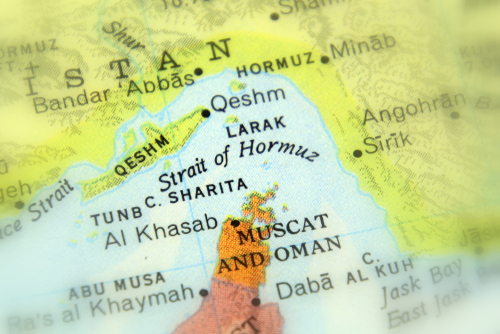
The Strait of Hormuz carries roughly 20 percent of global oil consumption and a comparable share of liquefied natural gas, with no overland substitute at scale for most Gulf producers. The International Energy Agency warned on 12 August 2026 that Hormuz-related losses would cut global oil supply by 4.3 million barrels per day across the year, and that a projected demand increase of 850,000 barrels per day had reversed into a decline of 1.6 million. Prices rose sharply, yet the escalation that many analysts anticipated did not materialise, because the largest buyer withdrew from the market at the same moment.
On 5 March 2026 China ordered its largest refiners to suspend diesel and gasoline exports, and refiners began cutting throughput and bringing scheduled maintenance forward within days. A structural change compounded the cyclical one. GL Consulting estimates that Chinese gasoline consumption will fall 5.5 percent in 2026, the second steepest decline after the lockdown year of 2022, with retail prices up roughly 30 percent since late February and electric vehicles absorbing a growing share of the fleet. China entered the disruption holding approximately 300 million barrels of cheap crude accumulated over the 14 months before the war, a buffer that is substantial and finite.
Central Asia is too integrated into external markets to insulate itself from a shock of this size, and yet the shock does not arrive directly. Kazakhstan ships most of its crude westward through the Caspian Pipeline Consortium rather than through the Gulf, and the region’s hydrocarbon trade with China moves by pipeline, which protects volumes while leaving prices exposed. External disturbances therefore reach Central Asian economies through three intermediaries, Russia, China and the European Union. Residents of the region learned the shape of that transmission in 2022, when the war in Ukraine reached household budgets through remittances, Russian banking channels and rerouted transit rather than through any direct commercial link. The present episode follows a different path. In Temirtau and Aktobe, where employment is concentrated in steel and ferroalloy plants, and in Karaganda region, the connection between a maritime chokepoint 3,000 kilometres away and local order books is neither obvious nor remote.
IMPLICATIONS:
The transmission runs through Chinese construction. China accounts for roughly half of world steel output, and construction absorbs about 49 percent of that steel, down from 58 percent in 2020. The property downturn has deepened rather than stabilised. Between January and May 2026, housing sales declined 10.8 percent by floor area and 13.5 percent by value, new construction starts fell 22.6 percent and property investment fell 16.2 percent. Weak demand for steel pulls down the inputs that Kazakhstan sells into it.
According to analysis published by the Kazakh sector channel Metals and ESG Trends.KZ, falling steel demand has depressed prices for iron ore, ferrochrome, silicomanganese and ferrosilicon, with ferrosilicon down by approximately 30 to 35 percent and pressure building on Qarmet, ERG and the country’s independent ferroalloy producers. These figures come from a sector channel rather than from exchange data and should be treated as indicative, though they are consistent with the direction of Chinese construction indicators.
The oil shock is mainly a reversible supply-and-refinery disruption, although China’s underlying oil-demand trend is weakening. The ferrous challenge is more structural: China’s property sector is unlikely to restore the previous steel-demand regime, while Chinese overcapacity may intensify competition in Kazakhstan’s surrounding markets. Kazakhstan therefore needs not only short-term support, but a multi-year strategy of market diversification, productivity improvement and product upgrading.
The more consequential implication concerns the logic of integration itself. Chinese investment in processing industries across Central Asia has reached an estimated US$ 11.8 billion against US$ 4.1 billion in energy, reversing the historically extractive pattern, and the China-Kyrgyzstan-Uzbekistan railway began construction in 2025. Nightingale Int. argued in October 2024 that Beijing would move from buying commodities in the region to embedding it in Chinese industrial chains, a forecast that BYD’s full localisation of electric vehicle production in Uzbekistan has since borne out. That investment is driven substantially by the same chokepoint exposure now visible at Hormuz. Central Asia is therefore receiving Chinese capital because China needs a continental rear, and absorbing Chinese demand shocks because it is becoming one. Deeper integration raises both the opportunity and the correlation.
Transit revenue moves with the same cycle, since corridor volumes through Central Asia are weighted toward Chinese cargo, and traffic on the Trans-Caspian Transport Corridor reached 4.5 million tonnes in 2024 before easing in 2025. Kyrgyzstan and Tajikistan face a different version of the problem. Neither exports ferroalloys at scale, and both carry sovereign debt to China equivalent to roughly 9.5 percent and 6 percent of GDP respectively, servicing obligations denominated against a creditor whose own fiscal position is tightening. A prolonged Chinese slowdown compresses their repayment capacity and their construction pipelines at once.
Kazakhstan’s emerging answer is visible in Karaganda region, where new copper extraction and processing projects are advancing and diversification into non-ferrous metals has become a working scenario for the sector. The direction is sound, and the caveat is familiar. Announced projects are not deployed capacity, and copper demand is itself concentrated in Chinese buyers. Diversification that changes the commodity while leaving the customer unchanged reduces exposure to one construction cycle and not to one counterparty.
CONCLUSIONS:
The Hormuz disruption has demonstrated that Central Asia’s exposure to global shocks is now mediated primarily through China, and that this channel operates in both directions. Beijing’s search for continental redundancy is drawing capital, factories and corridors into the region, while the maritime vulnerability that motivates that search transmits demand shocks back along the same route. If flows through the strait normalise within 2026, the oil-linked component will unwind. The ferrous component will not, because it rests on a Chinese property contraction that predates the conflict and is expected to persist. For Central Asian governments the practical lesson concerns buyers rather than corridors. Multi-vector policy has been articulated mostly in terms of routes and creditors, and the present episode indicates that the diversification that matters most is the diversification of demand.
AUTHOR’S BIOS:
Sobir Kurbanov is an international development expert and fellow at Nightingale Int. with over 20 years of experience in partnership-building, complex market reforms, program management, and teaching policy reform, public sector economics, and industrial policy across Eurasia. His expertise spans macroeconomic management, public sector governance, private sector development, trade, investment climate, infrastructure, and IF4D portfolio management, with a strong track record of working with bilateral and multilateral donors (SECO, DFID, USAID, IMF, WB, EU, UN), governments, CSOs, and think tanks, and leading cross-functional teams to advance evidence-based policy solutions.
Eldaniz Gusseinov is co-founder and Head of Research at Nightingale Int. and a non-resident fellow at Ibn Haldun University’s Haydar Aliyev Center for Eurasian Studies.