by Naveed Ahmad (the 08/21/13 issue of the CACI Analyst)
The Taliban finally have an address, far from their power base in Afghanistan. The place, commonly referred to as the “Taliban Embassy” by Doha taxi drivers, is receiving mixed reactions. After its opening on June 18, Pakistan welcomed the decision; India expressed caution that the office may confer “legitimacy” to the terrorist group while China found the development as “encouraging” and “positive progress.” Afghan President Hamid Karzai continues to stall the tripartite talks besides putting on hold a fourth round of negotiations on the status-of-forces agreement (SOFA) with the U.S.

Richard Weitz (01/23/2013 issue of the CACI Analyst)
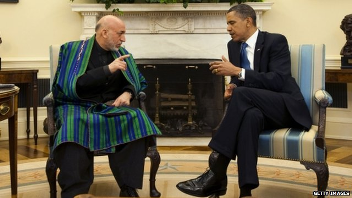
At their January 11 meeting, Presidents Barack Obama and Hamid Karzai pledged renewed cooperation as they transition the lead role in the Afghan War to the Kabul government. But many in Washington and beyond also saw this affair as an attempt to manage, if not a divorce, than at least a separation, as to the two leaders and their countries move off in different directions.
The Central Asia-Caucasus Analyst is a biweekly publication of the Central Asia-Caucasus Institute & Silk Road Studies Program, a Joint Transatlantic Research and Policy Center affiliated with the American Foreign Policy Council, Washington DC., and the Institute for Security and Development Policy, Stockholm. For 15 years, the Analyst has brought cutting edge analysis of the region geared toward a practitioner audience.
Sign up for upcoming events, latest news, and articles from the CACI Analyst.