The Wakhan Road and the Pamir Kyrgyz: Implications for Kyrgyzstan
By: Kubatbek Rakhimov
On October 4, 2026, Afghanistan’s Taliban government opened a 121-kilometer gravel road through the Wakhan Corridor to the Chinese border. Most commentary asks whether Beijing will open the Wakhjir Pass. A less visible question concerns the people along the road. Its eastern section crosses the Little Pamir, home to most of Afghanistan’s remaining ethnic Kyrgyz. Kyrgyzstan has supported them with state expeditions since 2008. This gives Bishkek a small but regular presence at a four-country junction. Yet Kyrgyz policy aims to resettle the community just as the road makes it relevant.
BACKGROUND:
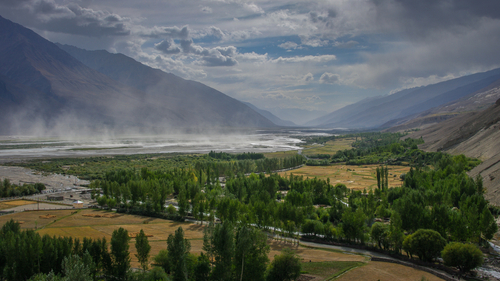
The road runs from Sarhad-e Broghil to the zero point on the Chinese border. According to Tolo News and Pajhwok, it was built in two phases for 365 million afghanis, about US$ 5.5 million, with Afghan funds and Afghan engineers. Officials list four bridges, 66 culverts and 3,100 meters of retaining walls. The surface is gravel. At Wakhjir, at almost 4,900 meters, there is still no official crossing point.
The corridor is Afghanistan’s only border with China. It separates Tajikistan from Pakistan. Sarhad lies below the Broghil Pass, which leads to Pakistan’s Chitral.
The eastern half of the road crosses the Little Pamir. Bozai Gumbaz, where the valleys meet, is a traditional Kyrgyz camping ground. The Pamir Kyrgyz descend from groups that arrived between the late 16th and early 20th centuries. Writing for ZOiS in 2021, Mahabat Sadyrbek noted that until 1973 they numbered around 10,000 and were assigned to patrol the border. War, Taliban rule in the 1990s and emigration to Pakistan, Turkey and Canada reduced their numbers. Kyrgyzstan’s Ministry of Labor, Social Security and Migration now puts the community at about 1,300 people in the Little and Big Pamir.
Bishkek’s engagement is regular. Since 2008 the government has sent expeditions with food, medicine and doctors. In October 2025, an expedition led by a deputy minister examined 765 people and delivered veterinary drugs. In August 2025, the Cabinet adopted a support program for 2026–2029, with progress reports going to the Presidential Administration. In 2021, after the Taliban takeover, a Kyrgyz delegation agreed with Kabul on the community’s safety and freedom of movement.
The community has few ways out. In July 2021, about 345 Afghan Kyrgyz fled to Tajikistan’s Murghab area. Within a week, Tajik authorities sent them back with some four thousand animals, citing security guarantees from Kabul.
The program’s main track, however, is resettlement. Fifty people were moved to Naryn in 2017, and eleven families to the Alai district in 2019. Some later went back to Afghanistan. In 2021 President Sadyr Japarov said he intended to bring the remaining Kyrgyz home. By May 2026, 172 Pamir Kyrgyz lived in Chon-Alai district, according to the Ministry of Labor.
IMPLICATIONS:
The road changes the cost of presence. Until now the Little Pamir could be reached only by long tracks. A graded road makes access cheaper for aid convoys. It does the same for Afghan officials, traders and security forces. Pajhwok reports that administrative units and health clinics have now been set up in Wakhan. The district governor has already asked for a road from Broghil to Ishkashim, which would tie the eastern section into the rest of the network. In 2022 the Taliban cabinet ordered a military deployment to the valley. The Afghan state is arriving in an area where its presence has been very limited, and where Kyrgyzstan was one of the few regular outside actors.
The road also increases the corridor’s political and economic importance. Kabul promotes it as a link between China and the Middle East. Beijing has not yet opened Wakhjir, although Badakhshan officials have claimed that the Chinese ambassador assured them that trade would begin once the road was finished and in April 2026, China created a new county on its side of the border. An opening will affect those living along the last sixty kilometers before the pass, including the small Kyrgyz population with an external patron. It can help maintain stability in the area, but could also become a humanitarian problem if traffic, checkpoints or newcomers interfere with its pastures.
For Kyrgyzstan, the community is the only basis for a legitimate Kyrgyz interest in the corridor and in the infrastructure now being built there. Kyrgyzstan has no border with Afghanistan and no share in the road. Without the Kyrgyz community, Bishkek is just another outside commentator on Wakhan. Yet with the community in pace, Bishkek gains three advantages.
The first is standing. Kabul acknowledged Kyrgyzstan’s interest in the community’s safety in 2021. That gives Bishkek a recognized reason to raise its concerns as the corridor develops, bilaterally with Kabul and Beijing or in the SCO. Its concerns are concrete: grazing rights at Bozai Gumbaz and along the road, free movement of herders and livestock, and access for aid if a Wakhjir crossing regime is ever agreed.
The second is a channel. Each expedition needs Afghan permits, escorts and local contacts in Badakhshan. Kyrgyzstan does not recognize the Taliban government, although it removed the movement from its list of banned organizations in September 2024. The expeditions give Bishkek a routine humanitarian line to Kabul that does not depend on recognition. This will become even more valuable in January 2027, when Kyrgyzstan takes its first seat on the UN Security Council. At the CICA summit in Baku this month, President Japarov again named Afghanistan’s stability as a priority for that term. A Council member with regular field access to at least one corner of Afghanistan speaks with more weight than one that relies solely on reports.
The third is continuity. Expeditions keep Kyrgyz doctors and officials in contact with the community each year, just as the area gains a road. If Wakhjir opens, Kyrgyz cargo could in theory reach Afghanistan through Irkeshtam and the Chinese road network, without Uzbek or Tajik transit. The community would then be a local interlocutor for Bishkek along that route.
The advantages have their limits and Bishkek’s engagement must stay humanitarian. If it presents the Pamir Kyrgyz as a political asset, Kabul or Beijing could read patronage of a border minority as interference, and the channel would close.
Yet full resettlement would remove all three advantages. Turkey offers a precedent. In 1982 Ankara took in more than a thousand Pamir Kyrgyz who had fled to Pakistan and settled them in Ulupamir, in Van Province. The move saved lives and the community grew. It also left Turkey with no stake in the Little Pamir. Sadyrbek recorded in 2021 that opponents of resettlement in Kyrgyzstan wanted the community to stay because of the area’s geostrategic weight. With the road built, their argument is no longer abstract. Resettlement also costs money. On September 30, 2026, MP Ulan Primov urged the government to address the need for jobs and adaptation for resettled Pamir Kyrgyz, noting that the state cannot support them financially forever. Bishkek is paying for a policy that also shrinks its presence in Wakhan.
Families should not be kept in hardship for strategic reasons. The choice to stay or leave belongs to them. Yet the weight of policy should move toward those who stay: veterinary care, schooling, mobile clinics and communications. That is now the most direct way for Kyrgyzstan to keep a voice at Wakhan.
CONCLUSIONS:
The Wakhan road is built, but it is not yet a trade route. Gravel, altitude, winter and a closed border still stand in between. The change so far is local. The Afghan state now reaches the Little Pamir by road, and Kabul has already put administrative units and clinics in place.
For Kyrgyzstan, the Pamir Kyrgyz are Bishkek’s main link to the last stretch of Afghan territory before China. That link rests on annual expeditions, the 2026–2029 program and a working arrangement with Kabul.
Resettlement is the weak point of that policy. By May 2026, 172 Pamir Kyrgyz lived in Chon-Alai district, while about 1,300 remained in Afghanistan. Bishkek should keep helping families who choose to move. But if it wants to maintain legitimate interests in Wakhan, it must invest in those who stay. Once the Afghan state settles in along the road, that choice will be harder to make.
AUTHOR’S BIO:
Kubatbek Rakhimov, PhD in Economics, is Director of Development at the Institute for Strategic and Academic Studies (ISAS), Bishkek. He works on transit corridors and the political economy of Central Asia. Note from the author: The idea, the case and the conclusions are mine. The core argument — that Kyrgyzstan should keep the Pamir Kyrgyz in place because the community is Bishkek's only lever in Wakhan — I made publicly on Kyrgyz television well before this road opened. The facts, the figures and the Turkish precedent of 1982 come from my own work on the region. I am not a native English speaker. In preparing the English text I used an AI assistant (Claude) for grammar and language editing. I reviewed and edited the full text myself and take full responsibility for every statement in it.
Visit also