
By Umair Jamal
Pakistan has upheld a policy of non-recognition of Israel since 1948, maintaining that diplomatic relations are contingent upon the establishment of a viable and independent Palestinian state with Al-Quds Al-Sharif as its capital. However, in late 2025, Islamabad’s mediation in the Gaza ceasefire and its conditional readiness to contribute forces to a UN-mandated International Stabilization Force have elevated its diplomatic profile with the U.S. and Gulf partners. Washington, alongside Saudi and Emirati counterparts, appears intent on expanding the Abraham Accords following credible progress toward a two-state solution. Pakistani participation would constitute a historic shift and unlock new economic corridors extending into Central Asia, enhancing regional connectivity to global markets.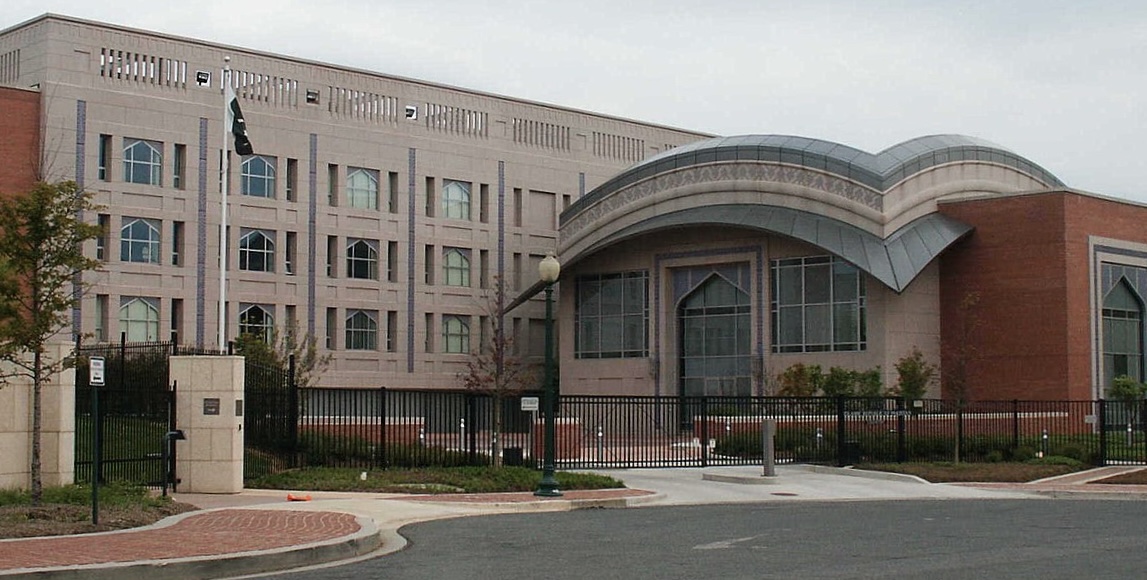
Credit: Wikimedia Commons
BACKGROUND: Pakistan’s official position on Israel remains firmly grounded in support for Palestinian self-determination, a stance that resonates strongly with domestic public opinion and has guided foreign policy since the country’s founding in 1947. Pakistani diplomatic passports explicitly prohibit travel to Israel, and public discourse frequently interprets the Israeli–Palestinian conflict through the lens of historical injustice, particularly the mass displacement of Palestinians in 1948.
Anti-Israel sentiment intensified across the Muslim world, including in Pakistan, following Israel’s large-scale military offensive in Gaza, which began in October 2023 in response to the Hamas attacks. The operation has thus far resulted in tens of thousands of Palestinian casualties and extensive physical destruction across the territory.
A majority of Pakistanis regard recognition of Israel as untenable in the absence of a sovereign Palestinian state. At the governmental level, however, pragmatic considerations have increasingly shaped Islamabad’s approach amid intensifying economic pressures, including a foreign debt burden exceeding US$ 130 billion and continued dependence on international financial institutions.
In September 2025, Prime Minister Shehbaz Sharif took part in a multilateral summit convened by U.S. President Donald Trump, alongside leaders from Saudi Arabia, Egypt, and Qatar, to endorse a 20-point framework for a Gaza ceasefire. The initiative, which enabled hostage releases and expanded humanitarian access, marked a significant instance of Pakistan’s active mediation, coordinated through Doha and other Middle Eastern diplomatic channels.
Subsequently, in November 2025, Foreign Minister Ishaq Dar confirmed Pakistan’s willingness to contribute troops to the International Stabilization Force (ISF) established under UN Security Council Resolution 2803. He stressed, however, that the mission’s primary focus would be civilian protection and post-conflict reconstruction in Gaza rather than the disarmament of Palestinian groups. “Our job is peacekeeping, not peace enforcement,” Dar stated when questioned about the prospective deployment of Pakistani forces. This position aligns Pakistan with a coalition of eight Muslim-majority states cooperating with the U.S. to support efforts toward stabilizing Gaza.
These developments coincide with the strengthening of Pakistan’s bilateral relationship with Saudi Arabia, formalized through a mutual defense pact signed in Riyadh on 17 September. The agreement commits both states to regard an attack on one as an attack on the other and encompasses broad provisions for military cooperation and joint deterrence. It underscores the two countries’ shared strategic interests amid heightened regional instability.
Saudi Arabia has signaled its openness to joining the Abraham Accords—a framework for the normalization of relations with Israel—conditional on credible progress toward a two-state solution. In recent remarks to President Trump, Crown Prince Mohammed bin Salman stated that Riyadh is prepared to participate in the Accords but seeks to secure “a clear path toward a two-state solution.”
Similarly, U.S. officials, including envoys from the Trump administration, appear to have encouraged Pakistan’s inclusion in this framework as a way to extend normalization efforts beyond the Gulf region. Although Islamabad continues to emphasize that any movement in this direction would depend on firm guarantees of Palestinian statehood, reports of backchannel exchanges suggest that discussions on the issue are evolving.
These shifts carry significant implications for Central Asia. States such as Kazakhstan and Uzbekistan are actively pursuing diversified connectivity options to reduce overreliance on Russian and Chinese infrastructure. Kazakhstan’s formal accession to the Abraham Accords in November 2025 illustrates this strategy, with the potential to strengthen its economic linkages with Israel and Western partners, particularly the U.S.
The prospective inclusion of Pakistan in the Accords could function as a pivotal connective link, but sustaining momentum would require careful management of domestic public opinion and sensitive regional dynamics.
IMPLICATIONS: If U.S. officials were to achieve their apparent objective of incorporating Pakistan into an expanded Abraham Accords framework, an outcome likely dependent on Saudi Arabia’s formal participation following progress toward a two-state solution, it would have significant ramifications for Central Asia’s economic landscape. The region’s republics, rich in hydrocarbons, uranium, and rare earth minerals yet constrained by geographic isolation, would benefit significantly from deeper integration into multimodal trade networks.
Foremost among these initiatives is the U.S.-backed India–Middle East–Europe Economic Corridor (IMEC), which incorporates Israeli routes and seeks to streamline freight transport from South Asia through Gulf ports to Europe. Designed to circumvent traditional chokepoints such as the Suez Canal, the corridor could reduce transit times by up to 40 percent. Pakistan’s participation could extend IMEC’s eastern flank through its ports at Gwadar and Karachi, interfacing with the China–Pakistan Economic Corridor (CPEC) to provide Central Asian exporters, particularly those in Kazakhstan and Turkmenistan. with viable southern outlets.
Such diversification would mitigate the vulnerabilities inherent in the Trans-Caspian International Transport Route (TITR), which, although operational, continues to face bottlenecks in Caspian Sea transit and persistent geopolitical frictions. In this context, enhanced Israeli technological inputs, such as advanced logistics software and desalination expertise, could improve the efficiency of these corridors, potentially generating annual trade gains amounting to billions of dollars for Central Asia by facilitating access to Mediterranean markets.
From a security standpoint, Pakistan’s prospective deployment of Islamic Security Forces (ISF) in Gaza, framed as a humanitarian stabilization mission, could serve as a model for multilateral engagement and potentially inspire analogous C5+1–style frameworks for managing Afghanistan’s borders. The Saudi–Pakistani defense pact concluded in September 2025 already signals deeper intelligence-sharing cooperation, which could extend northward to counter ISIS-K incursions threatening the frontiers of Tajikistan and Kyrgyzstan. Kazakhstan’s recent entry into the Abraham Accords, announced on 6 November during President Tokayev’s visit to the White House, further underscores this momentum.
Clear obstacles exist to the realization of this trajectory. Public opinion in Pakistan remains strongly opposed to normalization in the absence of Palestinian sovereignty, as demonstrated by sustained public protests and formal parliamentary resolutions. Consequently, any perceived capitulation to U.S. pressure could trigger political instability. Iranian concerns that IMEC represents an encirclement strategy, combined with its rivalry with Israel, could provoke proxy disruptions extending beyond Afghanistan into Central Asia. Moreover, China and Russia are likely to pursue countermeasures through their entrenched Belt and Road Initiative commitments, which already exceed US$ 25 billion in loans to Central Asian states. This could undermine regional cohesion and potentially exacerbate divisions, pitting Turkic-aligned states against Persian-influenced Tajikistan.
Yet a carefully calibrated strategy, linking reforms in Palestinian governance with the concurrent advancement of the IMEC corridor and an expanded role for Pakistan, could yield durable, region-wide dividends.
Israeli agricultural and water-management technologies, which have demonstrated effectiveness in arid environments, could contribute to the rehabilitation of the degraded Aral Sea basin and support the creation of tens of thousands of jobs across Uzbekistan and Kazakhstan.
Meanwhile, concrete U.S. incentives, such as the designation of Pakistan as a Major Non-NATO Ally Plus or the provision of security guarantees, could reinforce Islamabad’s willingness to resolve longstanding disputes with Afghanistan and India, facilitate full normalization with Israel, and finally enable the implementation of long-stalled connectivity projects, including the Uzbekistan–Afghanistan–Pakistan railway and the Trans-Afghan corridor.
The potential payoff could be transformative. Landlocked Central Asia would gain direct and competitive access to the warm-water ports of Gwadar, Karachi, and Mundra, unlocking billions of dollars in annual trade. This shift would also enable the region to diversify away from reliance on Russian and Chinese transit routes, thereby converting decades of geopolitical isolation into sustained economic prosperity.
CONCLUSIONS: Pakistan has conditioned recognition of Israel on the establishment of a viable Palestinian state for more than seven decades. That longstanding red line now appears to face its greatest pressure to date, as Islamabad’s effective mediation in Gaza and potential peacekeeping role have attracted praise from Washington and Riyadh. The U.S. is actively seeking to expand the Abraham Accords and aims to incorporate both Saudi Arabia and Pakistan once a credible two-state pathway is established. Should Pakistan ultimately accede, the economic payoff for Central Asia could be immediate, through faster IMEC and Trans-Caspian routes, expanded access to Gulf capital, and Israeli technology reaching the landlocked republics. Above all, this development could inaugurate a new era of integration adjacent to Central Asia that would benefit the region greatly.
Absent genuine Palestinian statehood, however, domestic opposition within Pakistan and regional resistance primarily from Iran could undermine these prospects. Ultimately, the outcome hinges on two factors: whether Pakistan can advance toward normalization with Israel without destabilizing its domestic political order, and whether the U.S. can deliver sufficient progress toward a credible and equitable two-state solution to provide Islamabad and other Muslim-majority states with the legitimacy required to take this step and unlock the region’s economic future.
AUTHOR'S BIO: Umair Jamal is a Ph.D. candidate at the University of Otago, New Zealand, and an analyst at Diplomat Risk Intelligence (DRI). His research focuses on counterterrorism and security issues in Pakistan, Afghanistan, and the broader Asia region. He offers analytical consulting to various think tanks and institutional clients in Pakistan and around the world. He has published for several media outlets, including Al-Jazeera, Foreign Policy, SCMP, The Diplomat, and the Huffington Post.