
By: Rafis Abazov
Kazakhstan is emerging as an important contributor to Afghanistan’s economic recovery and regional reintegration. Astana views economic development, human capital, and regional cooperation as essential foundations for long-term stability. Rather than approaching Afghanistan exclusively through the traditional security agenda, it seeks to combine trade, humanitarian assistance, educational diplomacy, and infrastructure connectivity. Kazakhstan’s engagement reflects a broader transformation in Central Asian diplomacy, in which neighboring countries seek practical solutions to shared development challenges. Future stability in Afghanistan depends on economic opportunities, strengthened institutions, and reconnecting Afghan society with regional development networks.
BACKGROUND:
For more than three decades, Afghanistan’s political instability, armed conflict, weak institutions, and disrupted trade routes have complicated Central Asia’s security and economic landscape and limited opportunities for regional integration. For Kazakhstan, despite the absence of a shared border, developments in Afghanistan have important implications for regional security, transportation, food markets, and economic cooperation.
New challenges for regional diplomacy arose with the return of the Taliban to power in August 2021. Economic uncertainty was compounded by international sanctions, restrictions on financial transactions, and the suspension of many development programs. At the same time, Afghanistan’s neighbors faced a difficult choice between diplomatic isolation and pragmatic engagement.
Kazakhstan increasingly favored the latter approach, maintaining working-level contacts while emphasizing humanitarian assistance, economic cooperation, and regional stability. While this approach does not imply unconditional political endorsement of the Taliban authorities, it recognizes the security risks across Central Asia stemming from Afghanistan’s prolonged economic isolation, including through deepened poverty and irregular migration.
The scale of Afghanistan’s humanitarian crisis illustrates the importance of sustained engagement. According to the United Nations’ 2026 Humanitarian Needs and Response Plan, approximately 21.9 million people, representing 45 percent of the population, require humanitarian assistance. Moreover, 17.4 million people were projected to face acute food insecurity during the 2025–2026 winter period. These figures demonstrate why economic stabilization and access to essential services remain inseparable from regional security.
Beyond simply preventing instability from spreading, the challenge for Kazakhstan is therefore to assist in establishing economic and institutional conditions that could gradually reduce Afghanistan’s dependence on emergency assistance.
IMPLICATIONS:
The implications of Kazakhstan’s engagement with Afghanistan extend beyond bilateral relations. Its emerging approach combines economic interdependence, humanitarian responsibility, and institutional cooperation. This could potentially provide a practical model for Central Asia’s wider involvement in Afghan stabilization.
First, economic cooperation is becoming an important instrument of regional stabilization. Kazakhstan is a major supplier of wheat, flour, vegetable oil, and other essential commodities to Afghanistan. According to Kazakhstan’s Ministry of Foreign Affairs, bilateral trade reached US$ 581.1 million between January and July 2026, exceeding the US$ 541.6 million recorded for the whole of 2025. However, trade remains highly asymmetrical as Kazakh exports accounted for US$ 572.9 million during the seven-month period, while imports from Afghanistan amounted to only US$ 8.2 million. These figures illustrate both the significance and limitations of current cooperation. Kazakhstan contributes to Afghanistan’s food security and access to essential commodities, while Afghanistan offers opportunities for expanding regional trade. However, sustainable economic integration requires moving beyond one-directional exports toward investment, agricultural processing, and stronger participation by Afghan enterprises.
Recent business forums in Kabul, Shymkent, and Herat demonstrate efforts to institutionalize commercial relations. Kazakhstan’s Deputy Prime Minister Serik Zhumangarin emphasized this approach, stating: “Afghanistan is one of Kazakhstan’s most important trade partners in South Asia.”
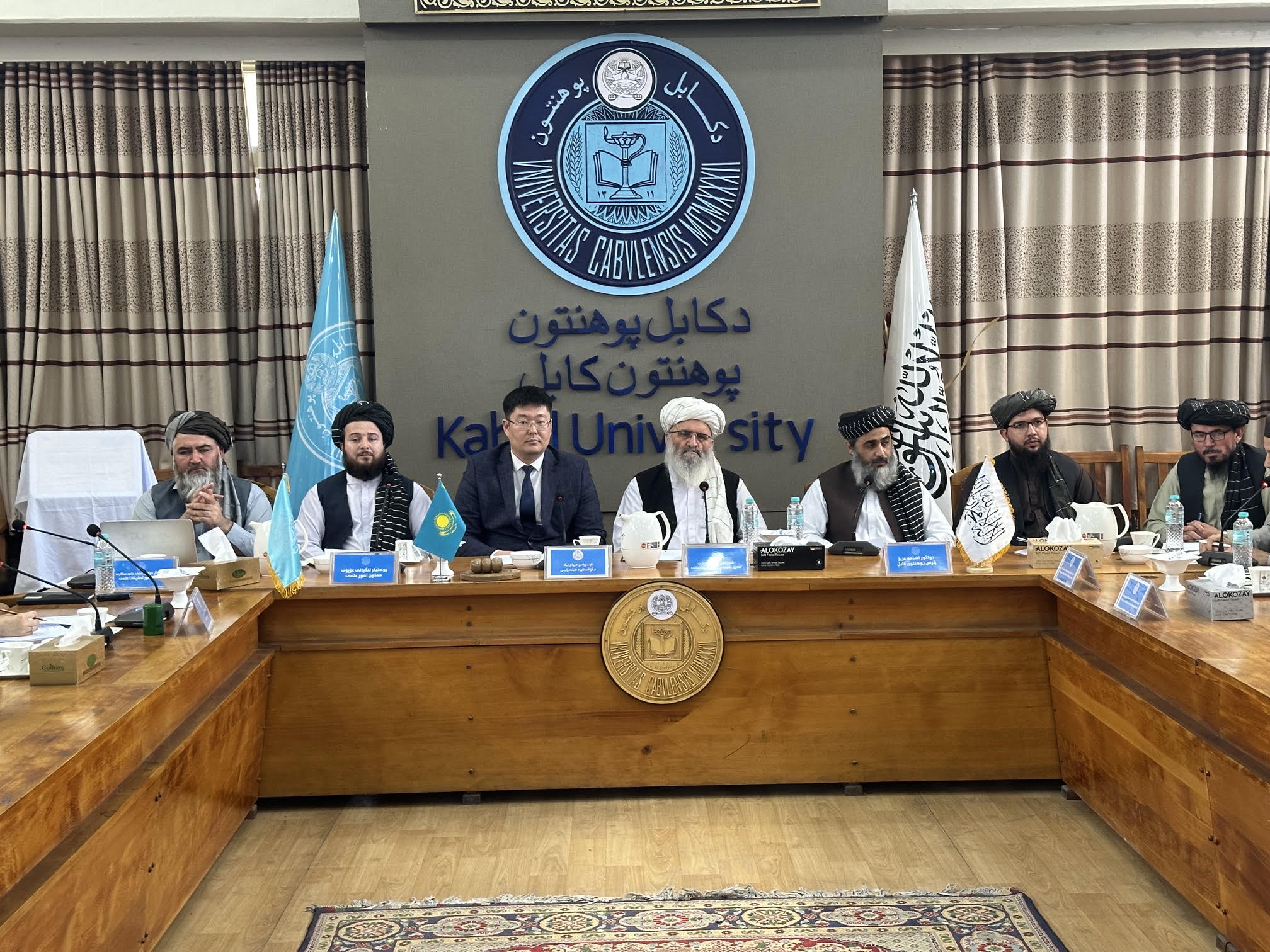
Second, educational diplomacy offers a longer-term investment in Afghanistan’s institutional capacity. Kazakhstan has provided educational opportunities for Afghan students through scholarships as well as university partnerships and internationally supported programs. According to government reporting, about 600 Afghan students were enrolled at 34 universities in Kazakhstan in 2026, with 30 educational grants allocated annually under an existing agreement. Authorities were also planning to increase the annual allocation to 60 grants. Beyond student mobility, these initiatives help develop professional networks connecting Afghanistan with Central Asian institutions. Graduates trained in engineering, agriculture, medicine, public administration, and other disciplines can contribute to rebuilding essential services and strengthening economic capacity. Particularly significant is the EU-supported initiative implemented through UNDP and UN Women, enabling Afghan women to pursue education in Kazakhstan, Kyrgyzstan, and Uzbekistan. The program demonstrates how educational cooperation can preserve professional opportunities for women despite severe restrictions on their participation in Afghanistan’s education system.
Third, humanitarian assistance reinforces Kazakhstan’s role as a regional partner. Through KazAID and government-supported missions, Kazakhstan has delivered food along with medical supplies, emergency equipment and other essential goods. In April 2025, Kazakhstan dispatched approximately 2,200 tons of humanitarian supplies by rail. Another shipment of 272.7 tons reached Afghanistan in September 2025, following the devastating earthquake. A high-level Kazakh delegation led by Deputy Prime Minister and Minister of National Economy Serik Zhumangarin visited Kabul on June 20–21, 2026, to deliver humanitarian aid and advance economic, educational, and transit cooperation. These deliveries illustrate an increasingly organized approach to humanitarian engagement rather than isolated diplomatic gestures. Medical cooperation adds another dimension. Kazakhstan has undertaken medical missions and discussed expanding healthcare assistance, including specialist consultations and support for emergency responses. Such initiatives are particularly relevant where shortages of medical personnel and restricted access to services undermine public welfare.
Fourth, transport connectivity could fundamentally change Afghanistan’s economic geography. Kazakhstan’s interest in railway development reflects a broader ambition to connect Central Asia with South Asian markets through Afghanistan. The proposed Turgundi–Herat–Kandahar–Spin Boldak railway corridor could provide additional routes for regional commerce. Kazakhstan has also participated in railway construction associated with the Khaf–Herat connection, strengthening the physical foundations of cross-border cooperation. However, infrastructure investment must be assessed against financing constraints, security risks, and uncertain commercial demand. The success of railway projects depends on reliable customs procedures, transparent transit arrangements, operational security, and commercially viable freight volumes. If these conditions are met, Afghanistan could gradually move from geographic isolation toward becoming an important transit connection between Central and South Asia.
Fifth, regional diplomacy provides an institutional framework for sustained engagement. Kazakhstan’s most consequential initiative may be its support for the United Nations Regional Centre for the Sustainable Development Goals for Central Asia and Afghanistan in Almaty. On March 4, 2025, the resolution establishing the Centre was unanimously adopted by the UN General Assembly and 152 countries supported the initiative as co-sponsors. This represents an important diplomatic achievement for Kazakhstan and creates opportunities to connect Afghanistan’s development needs with broader regional priorities.
CONCLUSIONS:
Kazakhstan’s approach to Afghanistan illustrates an emerging model of regional engagement that places economic opportunity, education, humanitarian assistance, and connectivity alongside traditional security considerations. Astana is developing practical instruments that can contribute to Afghanistan’s socioeconomic recovery.
The evidence suggests three strategic priorities. First, Kazakhstan should strengthen reciprocal trade and encourage Afghan participation in regional value chains. Second, educational assistance should increasingly emphasize professional development, women’s educational opportunities, and institutional capacity. Third, transport initiatives should be integrated with transparent financing, effective border management, and regional development programs.
The UN Regional SDG Centre in Almaty could provide an institutional foundation for coordinating these efforts and evaluating their long-term results. The Centre offers a potential platform for coordinating technical assistance, sustainable agriculture, climate adaptation, education, and institutional development. It could also encourage cooperation among Central Asian governments, international organizations, and Afghan stakeholders without requiring agreement on Afghanistan’s contested political arrangements.
Kazakhstan cannot resolve Afghanistan’s political and economic challenges independently. Nevertheless, its experience demonstrates that neighboring countries can contribute to stability through sustained, carefully calibrated engagement.
Ultimately, Afghanistan’s integration into Central Asia’s economic and educational networks should be understood as an investment in regional security and shared prosperity. The challenge is to translate growing diplomatic and economic cooperation into measurable improvements in Afghan livelihoods, institutional resilience, and opportunities for future generations.
AUTHOR’S BIO:
Rafis Abazov, PhD, is a director of the Institute for Green and Sustainable Development at Kazakh National Agrarian Research University. He is author of The Culture and Customs of the Central Asian Republics (2007) and An Effective Project Manager (2025). He has been an executive manager for the Global Hub of the United Nations Academic Impact (UNAI) on Sustainability in Kazakhstan since 2014 and facilitated the International Model UN New Silk Way conference in Afghanistan and other Central Asian countries.
AI STATEMENT: The author used AI tools for translation of sources, and for checking and editing grammar. The author takes full responsibility for the content and certifies that the ideas and analysis presented in the article are the author’s own.