
By Kodirjon Eshonkulov
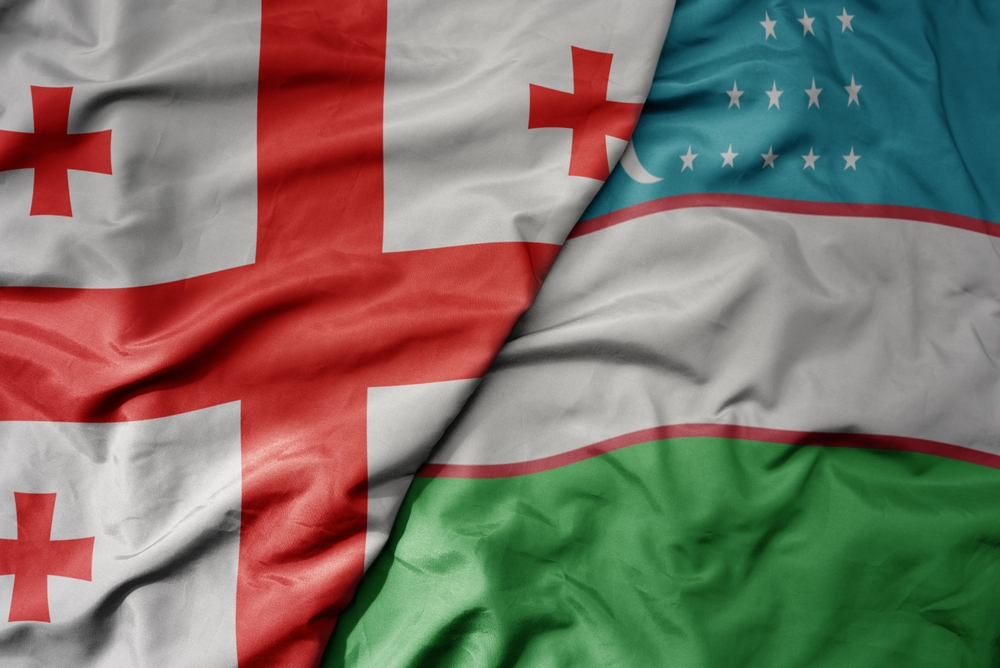
On July 2–3, 2026, President Shavkat Mirziyoyev paid Uzbekistan's first presidential state visit to Georgia in 23 years, elevating bilateral ties to a strategic partnership. Coming weeks after a similar upgrade with Kazakhstan and a wave of Georgian ministerial visits across Central Asia, the trip is not a bilateral curiosity but a marker of a structural shift: Central Asian states are actively re-anchoring their westward connectivity strategy in the South Caucasus, and doing so on terms decoupled from the European Union's political relationship with Tbilisi. For the future of the China–Kyrgyzstan–Uzbekistan (CKU) railway and Middle Corridor connectivity, the durability of this Caucasus terminus may matter as much as the eastern infrastructure itself.
BACKGROUND:
Uzbekistan and Georgia established diplomatic relations in 1994, formalized a year later through a Treaty of Friendship and Cooperation, and have since maintained a modest but steadily expanding relationship built on trade, direct Tashkent–Tbilisi and Tashkent–Batumi flights, and cultural exchange through Tbilisi's Georgian Cultural Center Megobroba, active since the same year. Bilateral trade reached roughly US$ 270 million by the end of 2025, a meaningful but still marginal figure relative to Uzbekistan’s overall trade portfolio. Momentum built gradually: Georgian Prime Minister Irakli Kobakhidze visited Tashkent in March 2025, and Days of Georgian Culture were held in Tashkent this past March.
What distinguishes the July 2026 visit is both its symbolism and its timing. Mirziyoyev’s trip was the first at head-of-state level in over two decades, and it produced a Joint Declaration establishing a strategic partnership, alongside sectoral memoranda spanning economy, healthcare, agriculture, finance, customs, education, ICT, and culture. Crucially, it did not occur in isolation. It followed Georgian Dream ministers’ consecutive June visits to Kyrgyzstan, Tajikistan, and Kazakhstan, and preceded Kazakhstan’s own strategic partnership agreement with Georgia (signed June 30 in Astana) by only days. A visit by Turkmenistan’s president to Tbilisi is reportedly also being prepared. Taken together, this is not a single bilateral gesture but a coordinated Georgian campaign to institutionalize relations across the entire Central Asian core, and a reciprocal Central Asian interest in securing a reliable Caucasus foothold. Beyond official protocol, the visit registers concretely at the level of Uzbekistan’s exporting businesses. Investment and Trade Minister Laziz Qudratov described how domestic manufacturers in textiles, food processing, and household appliances plan to complete final production stages inside Georgia’s Poti free economic zone before re-exporting to third-country markets — a practical illustration of how exporters, not only diplomats, are recalibrating around the Caucasus route. Local reporting on the visit also cited a nearly US$ 400 million prospective portfolio of hotel and residential projects tied to the deepening exchange. Georgian President Mikheil Kavelashvili, for his part, publicly framed the partnership as reinforcing Middle Corridor connectivity between the South Caucasus and Central Asia, suggesting the recalibration is felt on both sides of the route rather than driven solely from Tashkent.
IMPLICATIONS:
The logic behind this convergence is best understood through the lens of the Middle Corridor, the Trans-Caspian trade route linking Central Asia and China to Europe via the Caspian Sea, the South Caucasus, and the Black Sea, explicitly designed to bypass Russian territory. Since 2022, the corridor has moved from a secondary alternative to a strategic necessity for Eurasian trade planners, precisely because the northern route through Russia carries mounting sanctions risk and reputational cost. For Uzbekistan, this matters concretely: the CKU railway, once operational, will generate westward-bound freight that needs a credible onward path to European markets. Georgia's Black Sea ports, Poti and Batumi, are the corridor’s terminal gateway. A CKU line that ends without a secure, upgraded, and diplomatically stable corridor beyond the Caspian is a truncated asset. Mirziyoyev’s visit, and the accompanying attention to industrial, logistics, and tourism cooperation, should be read as an attempt to secure that missing western half of the chain.
This is where the visit’s timing against Georgia’s own geopolitical trajectory becomes analytically significant. Georgia’s EU accession process has been effectively frozen since 2024, following the Georgian Dream government’s foreign-agents legislation and its own decision to suspend accession talks until 2028. The European Council has described the process as being at a “standstill,” and the EU has cut assistance and partially suspended visa facilitation. Yet, notably, working-level cooperation between Georgian officials and their EU, NATO, and U.S. counterparts has reportedly continued largely undisturbed, and Brussels has kept investing in interconnection projects that run through Georgian territory, including Black Sea undersea cable plans advanced via a Romania-Georgia memorandum earlier this year.
This produces what might be called a decoupling of infrastructural and normative logics. Political-value alignment between Tbilisi and Brussels has deteriorated, but the geographic and commercial rationale for treating Georgia as an indispensable transit state has not, incentivizing Central Asian capitals to deepen engagement with Georgia on infrastructure, trade, and logistics. This gives Tashkent room to pursue a transactional, interest-based diplomacy toward the Caucasus, a pattern consistent with Uzbekistan’s broader post-2016 foreign policy style, which has generally prioritized connectivity and economic diversification over alignment with any single bloc’s political conditionality.
Armenia constitutes another important part of the equation. Georgia is currently viewed, including by Armenian officials, as the most EU-oriented state in the South Caucasus and as a de facto gateway for Armenia’s own European aspirations. Should Armenian-Azerbaijani normalization progress, particularly regarding transit arrangements sometimes referenced as the Zangezur corridor, a second Caucasus route could eventually supplement the existing Azerbaijan–Georgia axis, further reducing Central Asia’s dependence on any single transit state and adding redundancy to the Middle Corridor architecture. For now, however, the corridor’s practical backbone remains the Azerbaijan–Georgia pairing, with Uzbekistan’s new strategic partnership effectively buying insurance on the Georgian half of that pairing.
CONCLUSIONS:
Mirziyoyev’s Tbilisi visit should not be filed away as routine diplomatic housekeeping. It is best understood as one node in a broader, near-simultaneous Central Asian recalibration toward the South Caucasus, running parallel to, and largely independent of, the EU’s own frozen political relationship with Georgia. The distinction matters: it suggests that the Middle Corridor’s institutional foundations are being built on transactional infrastructure diplomacy rather than shared democratic conditionality, a divergence that may serve Central Asian connectivity interests in the near term but could complicate future efforts to fold these corridors into EU-backed connectivity frameworks such as Global Gateway. For the CKU railway’s long-term commercial viability, the durability of Uzbekistan’s new Georgian partnership, and the corridor’s insulation from further South Caucasus political volatility, will matter as much as the completion of the tracks themselves.
AUTHOR’S BIO:
Kodirjon Eshonkulov is an independent researcher specializing in Central Asian geopolitics, transboundary infrastructure politics, international relations with Europe and a recent graduate of Ajou University’s Graduate School of International Studies in South Korea. He was worked as a political correspondent on Uzbekistan’s social and political reforms after 2017. He has published several articles in The Times of Central Asia about Uzbekistan’s water scarcity problem and its relations with Afghan Taliban government on the Koshtepa canal.