Uzbekistan: A New Model for Reform in the Muslim World?

Uzbekistan: A New Model for Reform in the Muslim World?
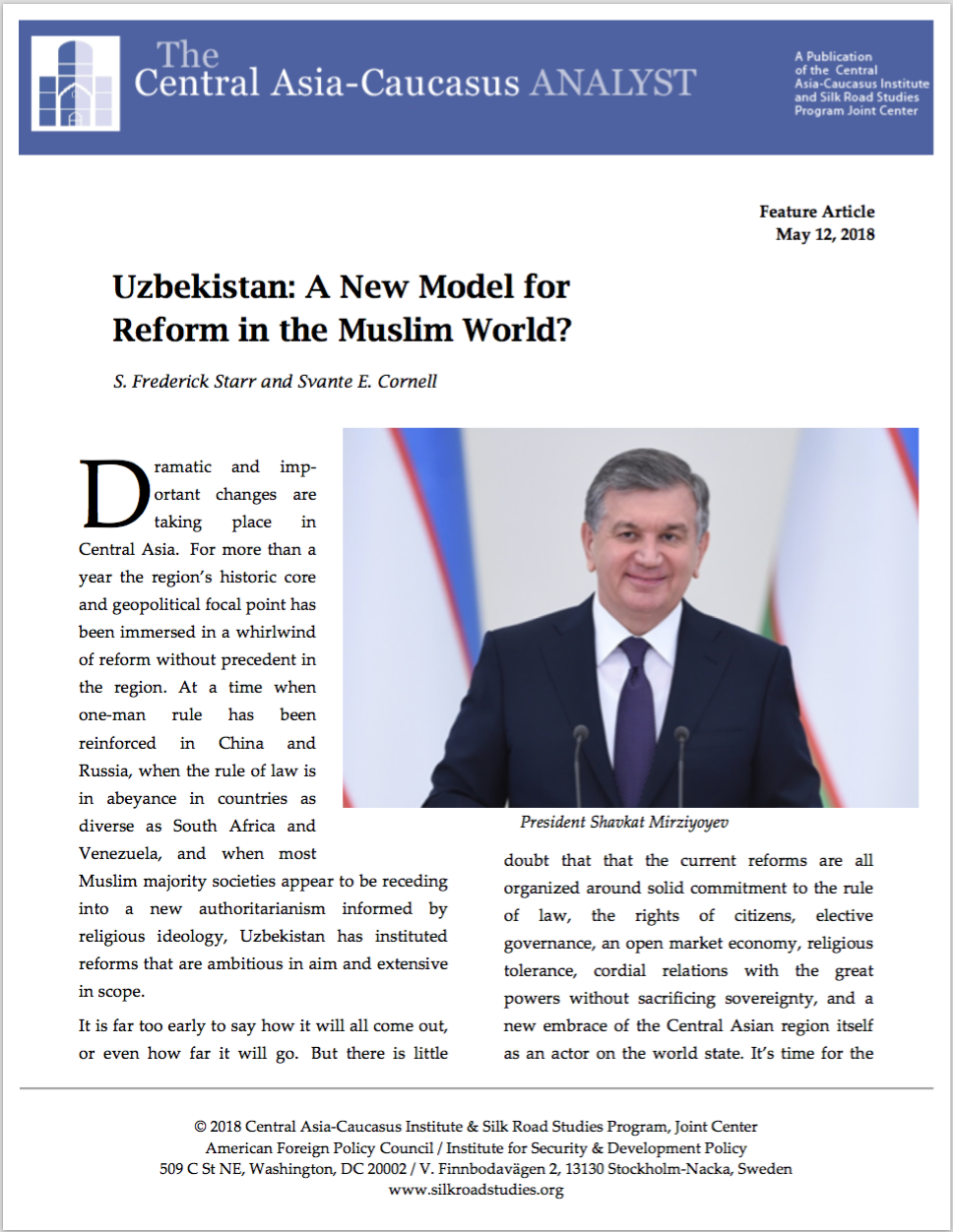
Dramatic and important changes are taking place in Central Asia. For more than a year the region’s historic core and geopolitical focal point has been immersed in a whirlwind of reform without precedent in the region. At a time when one-man rule has been reinforced in China and Russia, when the rule of law is in abeyance in countries as diverse as South Africa and Venezuela, and when most Muslim majority societies appear to be receding into a new authoritarianism informed by religious ideology, Uzbekistan has instituted reforms that are ambitious in aim and extensive in scope.
It is far too early to say how it will all come out, or even how far it will go. But there is little doubt that that the current reforms are all organized around solid commitment to the rule of law, the rights of citizens, elective governance, an open market economy, religious tolerance, cordial relations with the great powers without sacrificing sovereignty, and a new embrace of the Central Asian region itself as an actor on the world state. It’s time for the world to take stock of this startling development.
CACI Analyst, April 29, 2015
Contents
Analytical Articles
RUSSIA'S REGULATION OF LABOR MIGRATION SET TO HURT CENTRAL ASIAN ECONOMIES, by Nurzhan Zhambekov
MOSCOW CFE KILL THREATEN CAUCASUS STABILITY, by Richard Weitz
CAUCASUS EMIRATE FACES FURTHER DECLINE AFTER THE DEATH OF ITS LEADER, by Emil Aslan Souleimanov
KAZAKHSTAN AND NEIGHBORS SEEK STRATEGIES TO COUNTER EMERGING THREATS, by Jacob Zenn
Field Reports
KYRGYZSTAN'S PRIME MINISTER RESIGNS, by Arslan Sabyrbekov
ISLAMIC STATE REACHES OUT TO GEORGIA, by Eka Janashia
ARMENIA'S PRESIDENT VISITS THE VATICAN, by Erik Davtyan
AZERBAIJAN DEMOTED TO EITI CANDIDATE, by Mina Muradova
Hanging in The Trade Balance: Is Free Trade a Curse for Kazakhstan?

By Sergei Gretsky (06/10/2015 issue of the CACI Analyst)
The creation of the Eurasian Economic Union (EEU) was presented as a vehicle for economic development of Belarus, Kazakhstan, and Russia as a result of the removal of barriers to free movement of goods, capital, and labor between the three states and creating a common market. Its inauguration on January 1, 2015, happened at a very inopportune moment as Russian economy, the largest of the three, was sharply contracting due to falling global commodity prices and western sanctions over Ukraine. Economic recession in Russia has had a negative ripple effect on Belarusian and Kazakhstani economies, which led some in Kazakhstan to second-guess the benefits of joining the EEU.
Azerbaijan and Kazakhstan Face Tough Economic Decisions amid Decreasing Oil Price

By Nurzhan Zhambekov (04/01/2015 issue of the CACI Analyst)
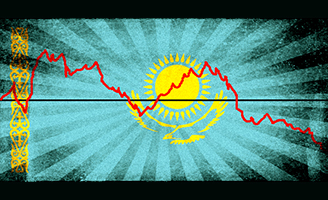
Azerbaijan and Kazakhstan face a tough year as oil prices plummet. A dramatic shift has occurred in the international oil market in recent months as oil supply has gone up, particularly with the U.S. oil production increase, and demand has weakened with the economic slowdown in China and the EU. Saudi Arabia, the world’s second largest oil producer, did not reduce its oil production despite the oil price decline, indicating that it would like to maintain its international oil market share. The precipitous decline in oil prices has resulted in a sharp fall in export revenues for Azerbaijan and Kazakhstan, the third and second largest oil producers respectively in the former-Soviet Union after Russia. This dramatic price drop has put the two countries’ currencies under severe pressure.
Tajik President Reviews Challenges in Annual Address To Parliament
By Oleg Salimov (02/18/2015 issue of the CACI Analyst)
Tajikistan’s President Emomali Rakhmon addressed the parliament in his annual speech on January 23, 2015. Rakhmon reviewed Tajikistan’s accomplishments in the socioeconomic sphere in 2014 and outlined his proposals for the country’s development in 2015. Rakhmon presented a highly detailed review of the work done by the Tajik government in 2014, highlighting numerous improvements supported by meticulous statistical data. In the speech, summaries of specific accomplishments were followed by appeals for further improvement.
In his annual address, Rakhmon focused mostly on economics, social problems, energy independence, transportation infrastructure, water resources, education and youth problems, and terrorism. Rakhmon specifically addressed the importance of developing a strong ideological basis in order to unify the people of Tajikistan and enhance their patriotism. Rakhmon also announced 2015 as the “Year of the Family,” translating into a separate set of tasks for the government and legislature in 2015. The president only cursorily mentioned Tajikistan’s parliamentary elections, even though these are scheduled to take place on March 1, 2015.
A few points in Rakhmon’s speech require closer attention. When speaking about economics, Rakhmon stressed the role of heavy industry, natural resources extraction, and Tajikistan’s hydroelectric power potential as it seeks to find its niche in the global market. In Rakhmon’s vision, the development of the agricultural sector is essential mostly for the country’s internal consumption and substitution of imported produce. According to Rakhmon’s speech, Tajikistan’s mid-term goal to transform from a largely agricultural society into a resource-supplying country with a perspective, in the long-run, to become a self-sufficient industrialized economy.
This enormous task can encounter such problems as insufficient human capital, technological deficiency, and inability of the state to attract necessary financial investments. Rakhmon touched on these problems as part of Tajikistan’s broader socioeconomic challenges, yet he made no direct reference to his proposal for economic transformation. The country’s transportation gridlock creates another obstacle for Tajikistan on its way to industrialization. The Turkmenistan-Afghanistan-Tajikistan railroad project, which started in March 2013 and would have provided Tajikistan with access to the Caspian and South-Asian markets, stalled as the participating countries disagree on the route of the railroad.
Tajikistan also continually suffers from an energy crisis. Although the country possesses a significant hydroelectric power capability, it suffers from a constant deficit of electricity vital for industrialization. While Rakhmon reports a significant increase in electricity production, the power limit for residential consumption remains at 6 hours daily in the winter time. Additionally, the hydroelectric power company Barki Tojik, which Rakhmon sees as an important player in advancing Tajikistan’s energy independence and hydroelectric power export, struggles with considerable financial difficulties. The company’s debt to suppliers and Tajikistan’s Taxation Department totals US$ 300 million as of August 2014. Tajikistan’s state budget is also cash strained as the export of aluminum, the main income-generating item, was cut from 216,000 tons in 2013 to 121,200 tons in 2014, according to the Minister of Economic Development and Trade Sharif Rakhimzoda.
Another significant part of Rakhmon’s speech was an appeal for constructing an ideological platform for Tajikistan, which must encourage patriotism, pride of the national and cultural heritage, and loyalty to the country’s interests. This task was in large part delegated to the Tajik Academy of Sciences. The ideology has to counterbalance propaganda hostile to Tajikistan. Rakhmon also underlined that, among other tasks, the Academy has to intensify its efforts to study the Tajik Civil War of 1992-97 and presenting more accurate and objective information on the issue as compared to other sources. It should be noted that last year a Tajik scholar from Canada was arrested in Tajikistan when trying to conduct research on the Tajik Civil War, unauthorized by the Tajik government. The apparent motive behind these proposals is to increase the legitimacy of the current regime. Rakhmon’s image as a peacemaker has helped him retain power for almost two decades and he intends to continue to do so in the future.
In general, Rakhmon’s annual address to parliament presented the same set of issues that the country has been trying to resolve since independence. As in last year’s speech, the current proposals for export increases, industrialization, energy independence, and resolution of the transportation impasse lacked specific plans for action and follow-up reviews. Besides, several factors and actors supposedly assisting the economic development process have collapsed or struggle to function, as seen in the example of the TAT railroad and Barki Tojik. Therefore, Rakhmon’s proposals constitute the acknowledgment of problems rather solutions to them.
Visit also




Staff Publications
 Silk Road Paper S. Frederick Starr, U.S. Policy in Central Asia through Central Asian Eyes, May 2023.
Analysis Svante E. Cornell, "Promise and Peril in the Caucasus," AFPC Insights, March 30, 2023.
Oped S. Frederick Starr, Putin's War In Ukraine and the Crimean War), 19fourtyfive, January 2, 2023
Oped S. Frederick Starr, Russia Needs Its Own Charles de Gaulle, Foreign Policy, July 21, 2022.
 Silk Road Paper S. Frederick Starr, Rethinking Greater Central Asia: American and Western Stakes in the Region and How to Advance Them, June 2022
Oped Svante E. Cornell & Albert Barro, With referendum, Kazakh President pushes for reforms, Euractiv, June 3, 2022.
Oped Svante E. Cornell Russia's Southern Neighbors Take a Stand, The Hill, May 6, 2022.
Silk Road Paper Johan Engvall, Between Bandits and Bureaucrats: 30 Years of Parliamentary Development in Kyrgyzstan, January 2022.
Oped Svante E. Cornell, No, The War in Ukraine is not about NATO, The Hill, March 9, 2022.
Analysis Svante E. Cornell, Kazakhstan’s Crisis Calls for a Central Asia Policy Reboot, The National Interest, January 34, 2022.
 Book S. Frederick Starr and Svante E. Cornell, Strong and Unique: Three Decades of U.S.-Kazakhstan Partnership, Central Asia-Caucasus Institute, December 2021.
Silk Road Paper Svante E. Cornell, S. Frederick Starr & Albert Barro, Political and Economic Reforms in Kazakhstan Under President Tokayev, November 2021.