
By Irakli Kiknavelidze and Tomáš Baranec
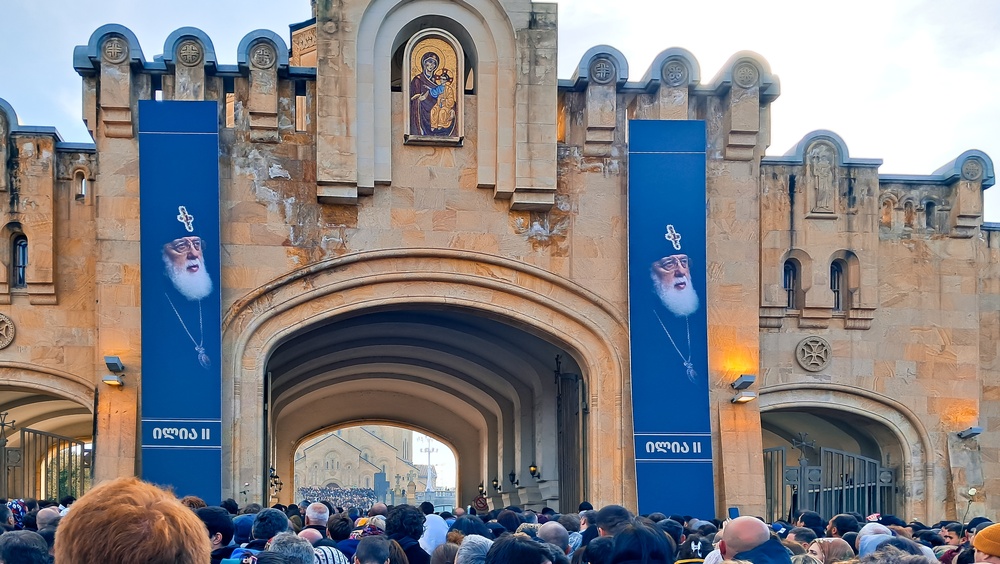
Ilia II of the Georgian Orthodox Church (GeOC) died on 17 March. Over nearly five decades, he consolidated the Church’s position as one of Georgia’s most influential and trusted institutions. His tenure was characterized by a dominant patriarchate, a relatively constrained Holy Synod, and a cautious approach to partisan politics and foreign policy alignment. The accession of Shio III marks the beginning of a new era for the GeOC, bringing expectations of a redefined balance between the patriarch and the synod, as well as potential consequences arising from the Church’s increased engagement in domestic and international politics.
BACKGROUND:
Under the 1995 Statute of Administration of the GeOC, the Holy Synod plays the central role in the election of the Patriarch. It is responsible for nominating three candidates and is the only body granted voting rights within the Extended Council, which selects the final candidate. All other participants, unlike under the pre-1995 system, serve solely in an advisory capacity.
Ideologically, the Holy Synod can currently be divided into three principal blocs. The conservative bloc is characterised by a dogmatic stance on cultural and ethical issues, scepticism towards Western integration, and, to varying degrees, openness to cooperation with the Russian Orthodox Church (ROC).
The national-conservative bloc often adopts an even more dogmatic position on cultural and ethical issues than the conservative bloc, while remaining strongly anti-Russian. Consequently, it is particularly sceptical of both the influence of the Russian Orthodox Church (ROC) and Georgia’s integration with Western institutions.
The liberal bloc, the smallest of the three, advocates more moderate positions on socio-ethical issues and is broadly supportive of Georgia’s political integration with Western institutions.
A heterogeneous yet numerically significant group within the Holy Synod consists of centrists, whose members are generally less ideologically committed and more pragmatic in their outlook than those belonging to the principal ideological blocs.
At its session on April 28, the Holy Synod nominated three candidates for the patriarchate, broadly reflecting the three principal ideological currents within the Church. Metropolitan Shio Mujiri, backed by the conservative wing, received 20 votes. The national-conservative bloc nominated Iob Akiashvili, who secured 7 votes, while the liberal wing put forward Grigol Berbichashvili, who also received 7 votes.
In the final vote held on 11 May, Metropolitan Shio Mujiri was elected head of the GeOC with 22 votes. Metropolitan Iob received nine votes, while Metropolitan Grigol secured seven. Mujiri was enthroned the following day, assuming the title Shio III.
IMPLICATIONS:
As one of the few senior figures within the GeOC to have received theological education in Russia, Shio has frequently been portrayed in the media as “Moscow’s candidate,” a characterisation openly used by Archbishop Zenon Iarajuli, among others. Critics have also pointed to his close relationship with Georgia’s ruling party. In contrast, Patriarch Ilia II maintained close ties with the Georgian state as an institution while generally avoiding overt alignment with any particular political party.
The accession of Shio III can be regarded as a significant success for the ROC, particularly with respect to the question of recognising the autocephaly of the Orthodox Church of Ukraine (OCU), which is a fully independent, autocephalous national church. Both of Shio’s rivals, Iob and Grigol, stated that they would support recognition of the OCU’s independence if elected. Shio, by contrast, avoided taking a public position on the issue during the election process. Given his longstanding ties to the ROC, it appears unlikely that he will endorse recognition of the OCU and will instead support the Moscow-affiliated Ukrainian Orthodox Church (UOC). As a result, the ROC can expect continued support from the GeOC on an issue of major strategic importance to Moscow, potentially for decades to come.
To an extent that remains uncertain, Shio’s accession is also likely to ensure the continuation of relatively close relations between the two Churches and to preserve a degree of ROC influence within the GeOC, at least intellectually and ideologically.
Compared with Ilia II, the new Patriarch’s initial public statements and appearances indicate that he may adopt a more uncompromisingly conservative stance, which will be difficult to reconcile with Georgia’s integration with Western institutions.
In this way, Shio may contribute to the strengthening of anti-Western attitudes among segments of the Georgian population. Such a development would align with Russia’s broader geopolitical interests while simultaneously reinforcing the legitimacy of the ruling Georgian Dream party among parts of its domestic constituency.
Even before his accession, Shio departed from Ilia II’s principle of supporting state institutions rather than specific political parties. Moreover, unlike Ilia II, Shio III is likely to enter his relationship with Bidzina Ivanishvili, the de facto leader of the ruling party, as a junior partner, at least initially.
An important factor in assessing the outlook of the new Patriarch is his background as a black (monastic) priest. Orthodox monasticism has traditionally been closer to the ROC (which is based on monasticism) than to the Greek Orthodox Church, which relies more heavily on white (married parish) clergy. As a result, Shio’s affinity with the Russian Orthodox world extends beyond his education in Russia. Whereas Ilia II’s faith was based on "Georgian Orthodoxy;" a faith with regard to the interests of the state, Shio III emphasizes Orthodoxy as a superior and supranational religious identity.
Shio III’s ties to Russia and support for the government appear to stem from deeply held personal convictions rather than political expediency. Consequently, a significant shift in these positions during his patriarchate is unlikely.
Nevertheless, the impact of Shio’s enthronement is likely to remain limited, at least during the initial years of his patriarchate. The fact that, after the first round of voting, when his victory had become virtually certain, there was no significant shift of centrist support in his favour (his tally increased by only two votes) suggests that members of the Holy Synod are not subservient to the new Patriarch and are prepared to oppose him if necessary.
Shio III has yet to display the political acumen that characterised Ilia II. His leadership is constrained by dogmatism and introversion, although he has shown an ability to rely on politically skilled allies and possesses some political instinct. The first major challenges of his patriarchate will reveal which of these traits proves more influential.
The GeOC will soon face several important internal challenges, including the appointment of seven vacant episcopal positions and the reform of the 1995 Statute of Administration. While there is broad agreement within the Holy Synod that the current statute requires revision, opinions differ sharply regarding its replacement. In addition, some bishops are actively advocating for the Church to publicly call for the release of political prisoners.
None of these issues falls within Shio III’s formal authority to decide unilaterally. To advance his preferred policies, he will need to secure the support of the Holy Synod. His handling of these challenges will provide an indication of his ability to shape the Church in accordance with his worldview.
CONCLUSIONS:
If Shio III consolidates his position, he could enable greater Russian influence within the GeOC and bolster the legitimacy of Georgian Dream among conservative voters. In the long term, however, this may weaken the Church’s broader social authority and deepen political polarization in Georgia.
In an alternative scenario, the Holy Synod could gain influence at the expense of the Patriarch. Even so, a major shift in the Church’s domestic or foreign policy positions is unlikely, as the recent patriarchal election demonstrated the continued dominance of the conservative wing within the Synod.
AUTHOR’S BIO:
Tomáš Baranec is a Research Fellow and Head of the Caucasus Program of the Slovak think tank Strategic Analysis. He worked for several years as a field researcher on the Georgian-Ossetian ABL. Tomas studied Balkan, Central European and Eurasian Studies at Charles University in Prague.
Irakli Kiknavelidze is a Georgian journalist, television host, political commentator, and media professional specializing in Georgian politics, democracy, religion, and South Caucasus affairs. He has worked in television, print, and digital media, producing interviews, analysis, and public affairs programming. Throughout his career, Kiknavelidze has focused on political developments, international relations, and the intersection of religion and public life in Georgia.